
Whistler Finally Got A World Cup. Downhill Should Be Nervous.
The sport’s loudest bike park has finally been handed a UCI Downhill World Cup. Great. Now watch everyone try to sanitise the very chaos that made Whistler matter.
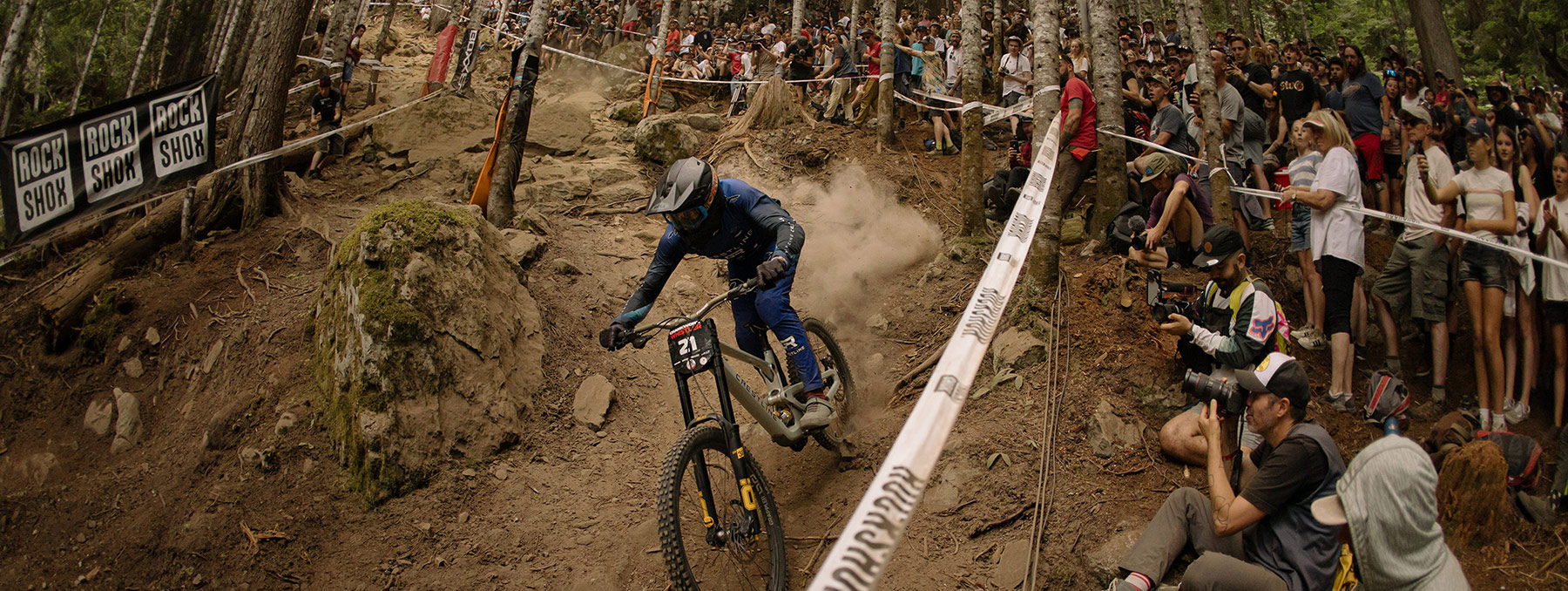
Whistler has finally got a UCI Downhill World Cup, and the funny thing is not that it took this long. The funny thing is that everyone is pretending this is just another calendar stop. It is not. This is downhill being marched into the sport’s most famous public workshop, where normal riders have been casing jumps, blowing corners, snapping derailleurs and lying about line choice for decades.
This is not another tidy resort stop
The Whistler round runs from 25 to 27 September, with elite qualifying on Saturday local time and finals on Sunday. For Australian insomniacs and genuine sickos, that means the serious stuff lands early Monday morning on the east coast. Yes, while road fans are still arguing about Montréal worlds tactics, the gravity crowd gets a different kind of exam: whether the UCI can handle a place where the audience actually knows what a fast line looks like.
The course is 1199, a purpose-built downhill track in the Creekside zone. That phrase, purpose-built, usually makes me reach for a bin. Too often it means a track sanded down until it suits television, sponsors and riders who would rather not discover what their front tyre is doing at 60 km/h. But Whistler is different. This is not a pop-up race in a paddock with a VIP fence and a DJ apologising into a microphone. It is mountain bike Disneyland, if Disneyland had brake bumps, pine needles and blokes in five-year-old knee pads offering setup advice nobody asked for.
Downhill does not need to become safer-looking. It needs to become clearer: brutal, legible, frightening, and still recognisably a bike race rather than a brand activation with timing chips.
The danger is not the rocks. It is the polish.
Whistler arriving on the calendar is a win for downhill, but not the kind the press releases want you to clap along with. The win is not tourism. It is not shoulder-season hotel occupancy. It is not the word global being dragged through another paragraph by someone in a fleece vest. The win is that a place built by riding culture has forced its way into the formal machinery of the sport.
That machinery will immediately try to tidy it up. It always does. The UCI wants broadcast schedules, predictable access, sponsor sightlines and a course map that looks expensive in a PDF. Resorts want visitors who buy accommodation packages and do not ask too many questions about trail closures. Brands want the hero shot, the launch moment and the new thing under the athlete before anybody in the comments can identify the linkage.
We have already had that gear theatre this week. Norco adidas Race Division turned up with custom frames, matching kit and the not-very-secret tease of unreleased adidas mountain bike shoes. Fair enough. Downhill has always been a better fashion sport than road cycling, mostly because its clothes are not designed to make accountants look like insects. But the equipment story only matters if the track makes the equipment matter. A new shoe is interesting. A new shoe landing sideways into a wet rock garden while the rider fights for two tenths is journalism.
Australia should be watching Troy Brosnan, not just the rainbow circus
There is an Australian reason to stay awake, and no, it is not another lazy chant about rugged Aussie toughness. Troy Brosnan sits inside the top ten of the men’s downhill World Cup picture and remains one of the most technically precise riders in the sport. He is not the internet’s favourite chaos gremlin. He is better than that. Brosnan rides like a mechanic who has already diagnosed the track and is slightly disappointed in everyone else’s preparation.
Luke Meier-Smith and Oliver Davis give Australia more than one pin on the start list, which matters because downhill has never been a participation ribbon discipline. It is hostile to excuses. You qualify, or you watch. You commit, or you get spat out. For a country that loves claiming it breeds tough riders, Australia still undersells gravity racing compared with road medals and Olympic-friendly narratives. That is daft. Downhill is one of the few cycling formats where the product is immediately obvious to a normal person: rider starts up there, finish line is down there, everything between is trying to remove them from the bike.
- Valentina Höll has already secured the women’s overall and arrives free to race like someone with no accountant in her head.
- The men’s overall is still alive, with Jordan Williams, Asa Vermette and Finn Iles carrying very different kinds of pressure.
- Jackson Goldstone brings the world champion’s jersey home to Canada, which is exactly the kind of storyline that becomes unbearable unless the racing is savage enough to deserve it.
- 1199 is new to World Cup racing, so setup sheets, local knowledge and nerve should matter more than stale reputation.
- Australian fans can watch the chaos on Stan Sport, which is cheaper than flying to Canada and pretending you were always into gravity.
Road cycling should be jealous
The road world is in Montréal right now doing what the road world does: calculating favourites, over-reading national tactics and pretending race radios are the only thing standing between us and romance. Fine. I love it too. But downhill has something road cycling keeps trying to manufacture and rarely can: instant consequence. One run. No hiding in a bunch. No domestique dragging you back. No neutralisation because the vibes got complicated.
That is why Whistler matters. It is not just a venue. It is a lie detector. If the UCI lets the place breathe, this weekend can feel like a genuine summit meeting between core riding culture and the professional series. If it gets over-managed, over-branded and over-explained, it will become another expensive reminder that cycling administrators can find the soul of a thing and immediately put a lanyard on it.
The best outcome is simple. Let the track be nasty. Let the riders look rattled. Let the crowd sound feral. Let the broadcast show the speed properly, not just drone glamour and slow-motion dust. Downhill does not need Whistler because Whistler is famous. It needs Whistler because fame, in this case, came from riders. Not committees. Not bid documents. Riders.
So yes, watch the road worlds. Watch the rainbow jerseys. Then set the alarm for Whistler and remind yourself what a bicycle looks like when there is nowhere to hide. If 1199 does its job, nobody will be talking about legacy on Monday morning. They will be talking about lines, mistakes, saves and whether the UCI has finally put downhill somewhere too good to control. That would be progress.