
The UCI Finally Counted Crashes. Women Were The Damage.
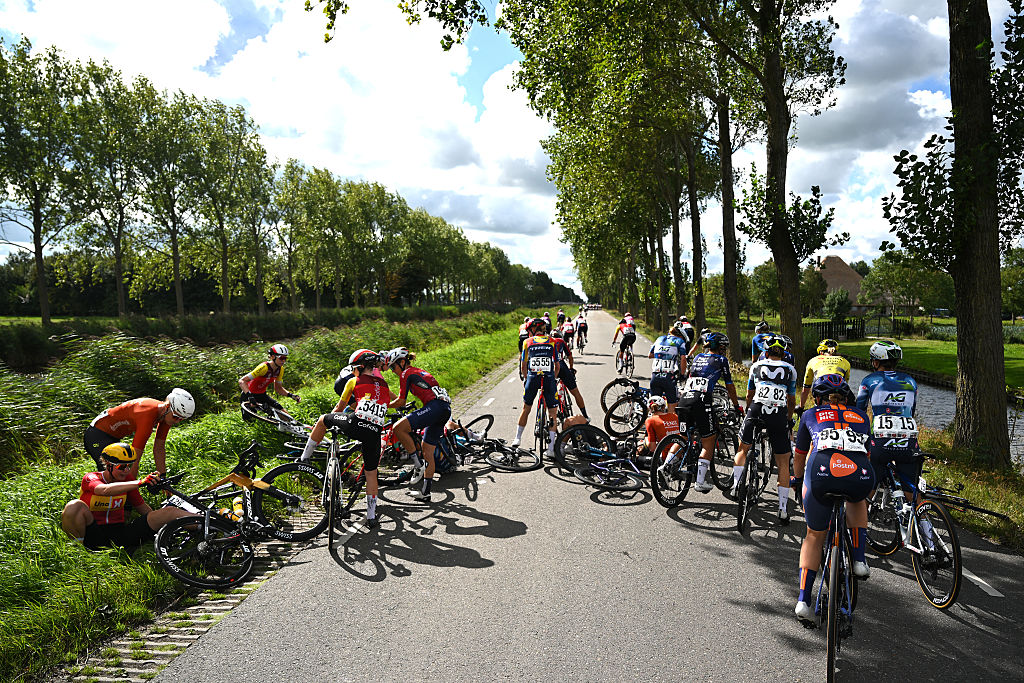
The first proper UCI crash data from 2026 says the quiet bit loudly: women are not just crashing, they are being hurt harder. If cycling files this under ‘safety update’ and moves on, it deserves every lawsuit coming.
Worlds week usually gives cycling a useful distraction. Rainbow jerseys, national flags, soft-focus suffering, a few patriotic tears, and enough sponsor logos to wallpaper a velodrome toilet block. But in Montréal this week, away from the podium ceremonies and course previews, the UCI dropped something harder to cheer: preliminary crash data showing women’s WorldTour riders are being injured more often and more severely than men.
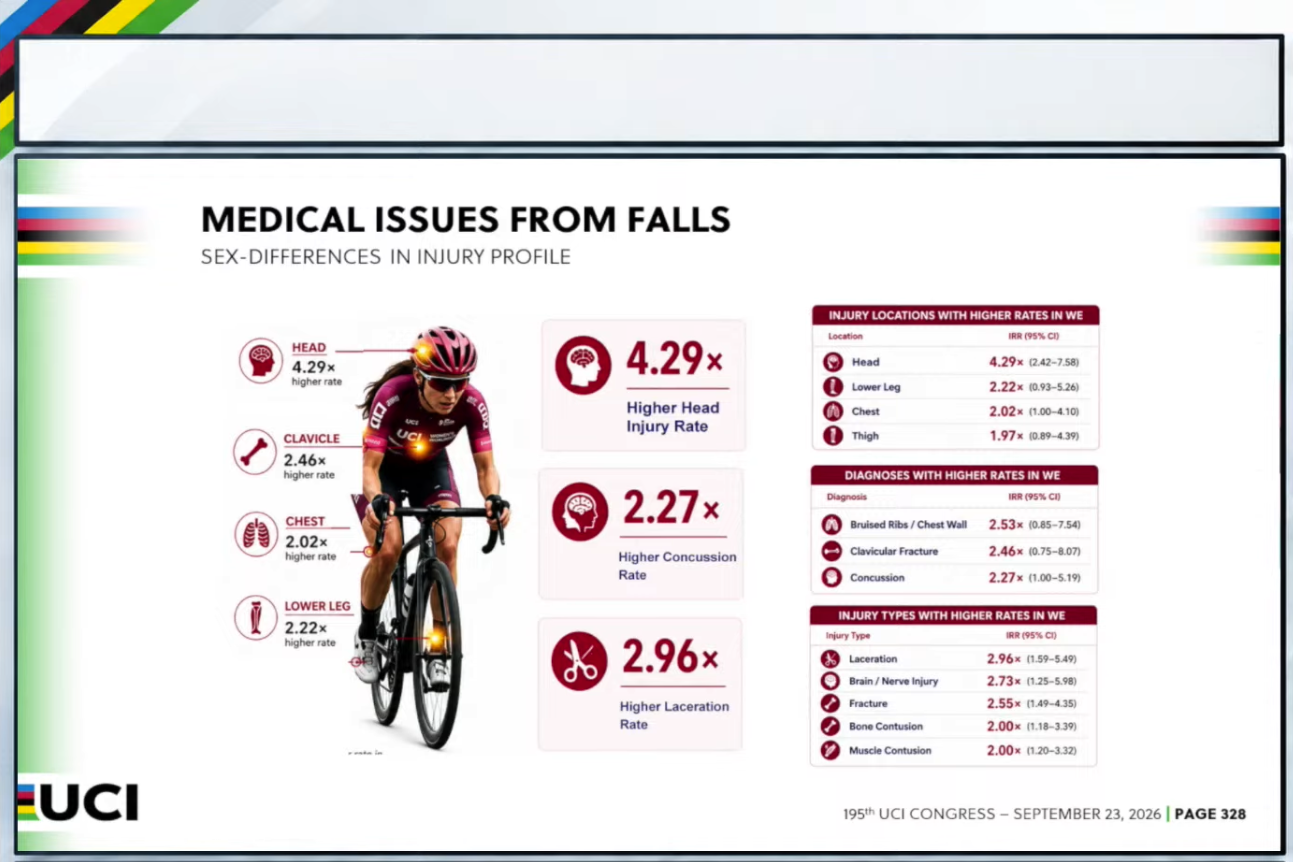
Not vibes. Not rider grumbling. Not the usual anonymous DS muttering that “the women’s bunch is nervous”, which is often just sexism wearing a team polo. Actual data. UCI Medical Director Xavier Bigard presented the early results at the annual Congress on Wednesday 23 September, drawn from monitoring that began at Paris-Nice and covered 21 men’s races across 90 days and 14 women’s events across 37 days. The numbers should make every organiser, team boss and federation official sit up straight.
The numbers are ugly because the problem is ugly
According to the study, crashes in women’s races involved an average of 4.7 riders, compared with 2.7 in men’s races. Incident rates were about 1.3 times higher for women. Crashes requiring medical contact were 1.5 times higher. True injuries, meaning tissue damage, abrasions, concussion, fractures and the rest of the horrible post-race vocabulary, were 1.55 times higher.
Then it gets worse. Bigard’s presentation pointed to 4.3 times more head-level injuries in women, roughly 2.3 times more concussions, nearly three times more severe skin lesions, and about 2.5 times more fractures. If this were a bike recall, every distributor in Australia would be panic-emailing dealers before lunch. Because it is women’s bodies, cycling will be tempted to call it preliminary and wait for another season of scar tissue.
Cycling loves marginal gains until the marginal gain is keeping women out of hospital.
Do not blame the bunch and go home
The laziest possible reaction is to mutter about skill heterogeneity. Bigard did raise that as one possible hypothesis, and he also mentioned bone health, hormonal disruption and low energy availability as possible factors behind fracture rates. Those are serious issues. Women’s cycling has grown faster than the systems around it, and a peloton containing Olympic track engines, teenage neo-pros, late converts, underfunded domestiques and stars on newly serious salaries is not the tidy closed shop the men’s WorldTour pretends to be.
But if your first instinct is to point at rider ability, you are already reaching for the broom. The study has not yet found clean contributing factors in the women’s field. Weather, race phase, experience, wind and rain did not provide the easy answer. Descents were severe for both men and women, because gravity does not check your contract value. The real scandal is not that women crash. The scandal is that cycling has professionalised the marketing of women’s racing faster than it has professionalised the safety architecture underneath it.
Australia should be paying attention, not feeling smug
There is an Australian thread here, and not just because we currently have half the country pretending to understand Montréal time zones. Maeve Plouffe’s Tour of Britain Women scare in August, when she described public cars coming at her from multiple directions after a puncture and a long chase, was not some distant European farce. It was a warning flare for every race run on rolling closures, thin police resources and the magic belief that a high-vis vest creates a force field.
Australian road racing knows that model intimately. Club racers know it. NRS riders know it. Juniors know it. Masters know it. The difference is that the WorldTour has television cameras and medical directors with slides. Local riders usually get a traffic cone, a commissaire with a radio, and the instruction to keep left unless the course map says otherwise.
AusCycling should not wait for the UCI to finish its database before acting domestically. If road racing in this country wants to be taken seriously, every national-level event should publish minimum barrier standards, convoy protocols, medical coverage, neutralisation rules, and post-race incident data. Not buried in a PDF nobody reads. Public. Comparable. Uncomfortable. That is how grown-up sport works.
- WorldTour and Women’s WorldTour organisers must adopt the 2027 finish-barrier standards early, not when forced.
- GPS rider and vehicle tracking should be treated as basic safety equipment, not a stakeholder negotiation about data ownership.
- Women’s race organisers need the same road closure ambition sold to men’s races, especially when riders are dropped or chasing back through convoy gaps.
- Teams should stop treating RED-S and bone health as private misfortune and start treating it as performance-critical safety work.
- Australian events should record and publish crash causes, medical response times and course hazards before pretending another risk assessment spreadsheet solved the problem.
The UCI is late, but at least it is counting
Credit where it is due, the UCI is at least moving. Montréal also confirmed stricter barrier requirements for the final 200 metres of WorldTour and Women’s WorldTour races from 2027, plus renewed pressure for GPS safety tracking across professional road racing. That matters. Barriers are not furniture. They are crash surfaces. Convoys are not scenery. They are moving hazards. A rider on the deck is not content. She is a worker injured at work.
Still, cycling’s favourite tactic is to announce a framework and then age it like a French cheese until everyone forgets who was meant to implement it. We have seen this with barriers. We have seen it with extreme weather. We have seen it with race vehicles. We are seeing it with GPS trackers two years after Muriel Furrer’s death made everyone swear they understood urgency.
So here is the blunt version. Women’s cycling does not need more inspirational copy about growth. It needs safer courses, better closures, proper medical systems, honest data and organisers who understand that equality is not giving women a start arch and a drone shot. Equality is making sure the risk budget is not silently loaded onto smaller bodies, weaker bargaining power and calendars still fighting for basic respect.
The peloton has always accepted danger. That is not the same as accepting negligence. The UCI has finally counted enough crashes to show what many riders already knew through collarbones, concussions and shredded skin. Now the sport has a choice. It can treat this study as a medical curiosity, or it can admit that women’s racing has been asked to grow at WorldTour speed on safety systems still stuck in clubland.
If the next answer is another consultation, spare us. The women have already supplied the evidence. Mostly by hitting the ground.