
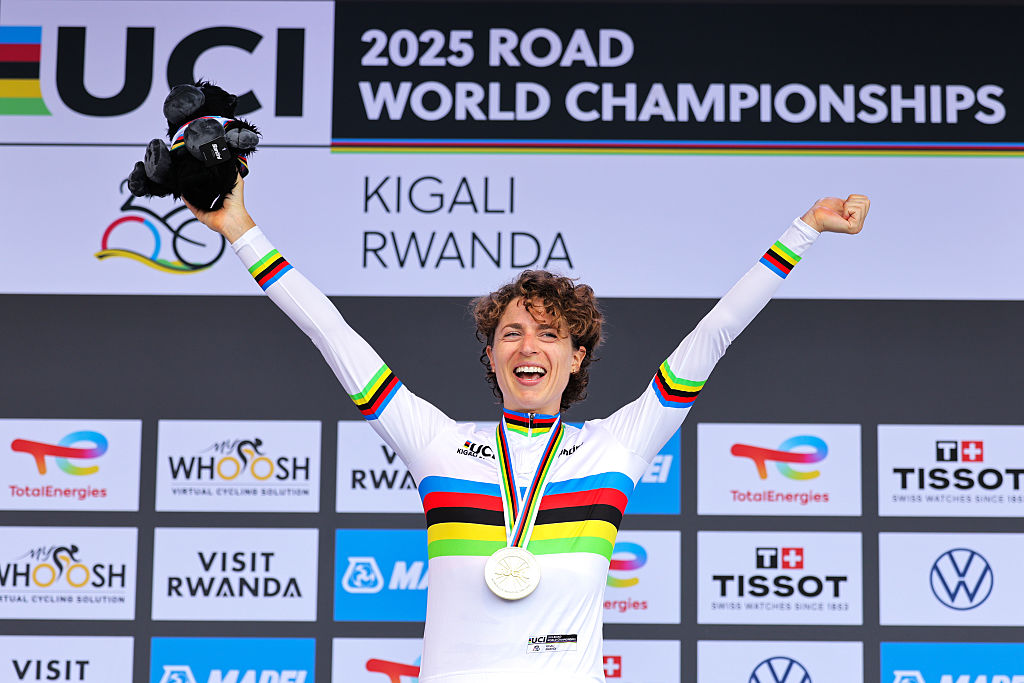
The Worlds Starts With The Clock. Stop Calling It The Warm-Up.
Montréal 2026 opens with 39.2 kilometres of truth serum, and for once the women get the full dose. If you still treat the time trial as a curtain-raiser, you are watching the wrong sport.
The 2026 Road World Championships begin in Montréal on Sunday 20 September, not with a bunch sprint, not with a Pogacar-shaped coronation parade, not with some tactical seminar where everyone pretends sitting sixth wheel is a personality. They begin with the individual time trial, which is exactly how a world championship should start: one rider, one bike, one course, and no domestique left to blame.
The elite women roll out at 9:00am local time, which is 11:00pm AEST on Sunday night for the east coast masochists. The elite men go at 12:45pm in Montréal, or 2:45am AEST on Monday morning. In other words, Australia gets the time trial in its purest viewing format: sleep-deprived, mildly resentful, and with a mug of tea strong enough to strip paint.
Same course. Same distance. About bloody time.
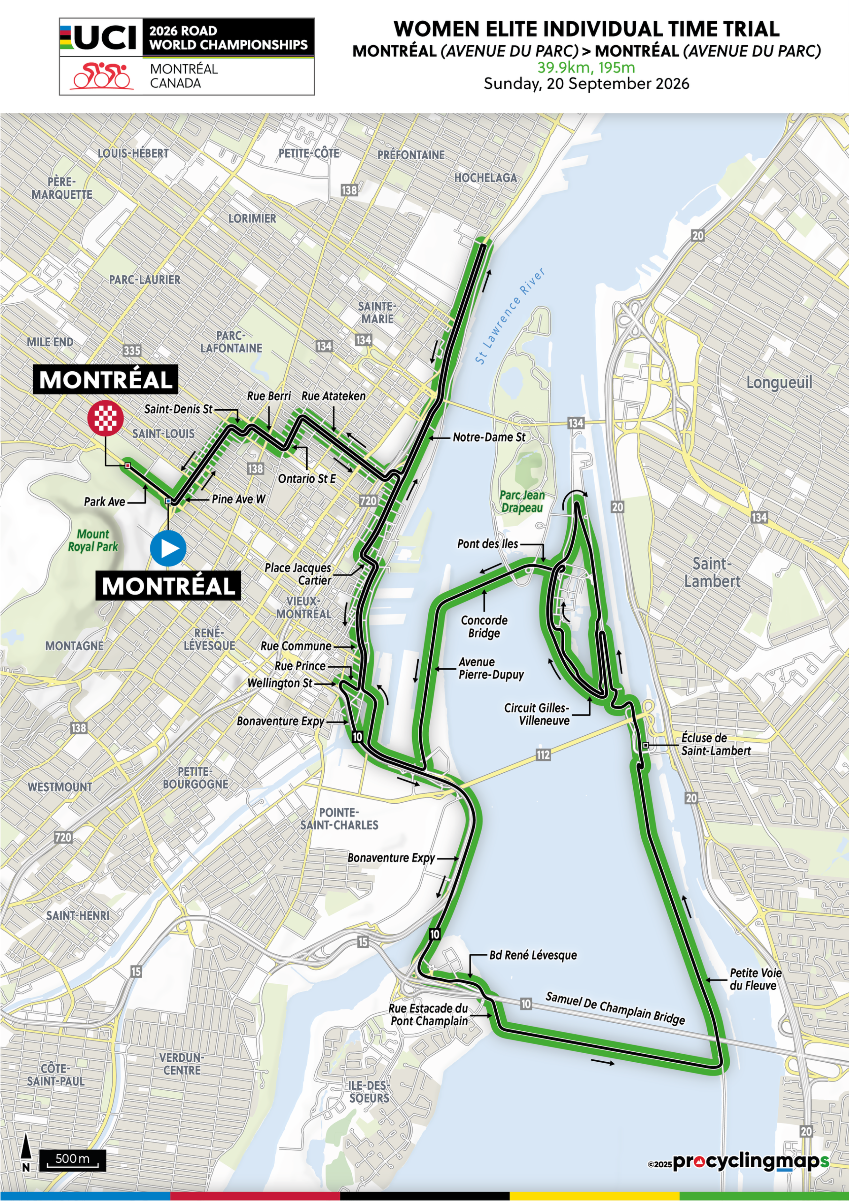
The headline is not just Remco Evenepoel versus Filippo Ganna, though that is the obvious heavyweight fight. It is not just Marlen Reusser versus Demi Vollering, although that is the race with the better tension. The headline is that the elite women and elite men are scheduled for the same 39.2 kilometre course, with 220 metres of elevation. That should not feel radical in 2026, but cycling has spent decades acting like equality is a logistical problem rather than a choice.
This is reportedly only the third time since the women’s Worlds time trial was introduced in 1994 that the women have raced the same distance as the men. It is also the longest women’s individual time trial in Road Worlds history. Read that again before someone in a blazer congratulates the sport too loudly. The bar was not high. It was lying on the carpet under a hotel conference table.
This is not a warm-up. It is the audit.
The Montréal course is not a sterile dragstrip. It starts downhill, uses the city and riverfront, takes in the Circuit Gilles-Villeneuve precinct, then finishes with a 400 metre rise at a little over six percent. That last ramp matters. It is short enough that a pure aero brute will tell themselves it is irrelevant, and steep enough that their legs may file a formal objection in the final minute.
Good. A world title should not be won by the rider who can simply hold a stupidly narrow position on a dead-flat bypass for 40 minutes. It should reward the full, ugly craft: pacing, cornering, equipment choice, tyre pressure, position, nerve, and the ability to keep making decisions while your lungs are trying to leave through your visor.
A time trial is where cycling stops lying. No lead-out, no lucky breakaway composition, no team radio poetry. Just the bill for every decision you made before the start ramp.
The men’s race is a lab test with calves
Evenepoel and Ganna arrive as the obvious poles of the men’s race. Between them, they have owned most of the recent rainbow-clock conversation, with five of the past six elite men’s world time trial titles sitting in that orbit. Evenepoel is the modern template: compact, violent, absurdly efficient, and apparently designed by someone who thought boredom was a solvable problem. Ganna remains the big-engine romantic, the man who can make 56 teeth look like commuting gear when the road opens up.
But the time trial is not just legs. It is a money pit with a timing mat. Helmets that look like escaped kitchen appliances, base bars that cost more than your first car, skinsuits treated like state secrets, chain wax rituals that would embarrass a cult. The discipline is brutally honest about what elite cycling has become: physiology plus engineering plus budget, all wrapped in national federation competence.
That is why the women racing the same course matters. Equality is not just distance on a PDF. It is forcing teams, sponsors and federations to take the preparation seriously. If the women are asked to ride the full test, they must be given full equipment, full recon, full aero support and full respect. Anything less is not old-school. It is cheap.
Australia has no hiding place this week
Australia arrives with a complicated time trial story. Jay Vine, a 2025 individual time trial medallist, is out through illness. That hurts, especially because Vine is exactly the kind of rider who can turn a course like this into a controlled argument with gravity. In the elite events, Lauretta Hanson is listed for the women’s individual time trial, while Conor Leahy, the Oceania champion, takes the men’s start. Neither gets the luxury of anonymity now.
Then comes the mixed relay on Tuesday 22 September, where Australia has won the last two editions. That is not a cute footnote. It means the program has expectations, not vibes. The mixed relay is often treated like a novelty act by people who have never tried to hold a formation at threshold while three riders slowly disintegrate at different rates. It is one of the few events that exposes whether a nation has a system or just a handful of stars.
- Lauretta Hanson gets the elite women’s individual test on Sunday 20 September.
- Conor Leahy carries the elite men’s TT start as Oceania champion.
- Mackenzie Coupland, Sophia Sammons and Felicity Wilson-Haffenden give Australia serious under-23 women’s time-trial interest.
- Wil Holmes and Thomas Waites are listed for under-23 men’s time trial duty.
- The mixed relay on Tuesday 22 September is the pressure event, because Australia is no longer a pleasant surprise there.
This is where Australian cycling should be greedy. We spend plenty of time congratulating ourselves for producing hard riders from hot roads, wind, track programs and country crits. Fine. But a modern Worlds time trial asks a colder question: can you build the whole apparatus around the athlete? Not just a fast rider. A fast rider in the right position, on the right equipment, with the right pacing plan, with the federation paperwork done before everyone is already panicking at the airport.
The bike shop lesson is sitting in plain sight
For ordinary cyclists, the Worlds time trial is both inspiring and ridiculous. You do not need a $20,000 superbike to get to work, win B grade, or enjoy a Sunday smash. But you can learn plenty from the discipline’s obsession with position and repeatability. Most riders would gain more from fixing their reach, saddle height, tyre choice and clothing than from buying another carbon trinket advertised as marginal gains by someone who has never cleaned a drivetrain properly.
That is the delicious hypocrisy of the time trial. It is cycling’s most expensive purity test, and also its simplest. Can you hold the shape? Can you produce the power? Can you pace the effort? Can you stop fiddling with your computer long enough to ride the bloody bike? The pros answer those questions with wind tunnels and national team mechanics. The rest of us answer them on a Tuesday night loop with a headwind and one bottle cage rattling loose.
So yes, stay up for the elite women. Set the alarm for the men if you are truly diseased. Watch the helmets, the positions, the split times, the final climb, the riders who look perfect at kilometre ten and haunted by kilometre thirty-five. Montréal is about to spend a week selling romance, tactics, flags and rainbow mythology. But before all that, the clock gets first word. It usually tells the truth.