
The Tour’s First Real Mountain Test Is Being Ridden Without Fans. That Should Scare Every Cyclist.
Stage 3 of the Tour de France was meant to be the first proper Pyrenean slap. Instead, wildfire has turned the French finale into a stripped-back, no-caravan, no-spectator warning shot.
The biggest story at the Tour de France tonight is not Jonas Vingegaard in yellow, not Tadej Pogacar playing benevolent emperor on Montjuic, and not another team bus full of nervous directors pretending they have a plan. It is this: tomorrow’s Stage 3, Granollers to Les Angles, will enter France under an instruction that sounds impossible for the Tour. No spectators on the French section. No publicity caravan. Only riders and essential race vehicles.
That is not a logistical wrinkle. That is the sport being told, politely but firmly, to get out of the way while the real emergency takes priority. The Pyrénées-Orientales wildfire has forced French authorities and race director Christian Prudhomme into an exceptional format for Monday, 6 July 2026. The final stretch from Ur to Les Angles, the bit that should have been packed with campers, flags, cowbells, sunburnt Belgians and overexcited kids leaning over barriers, is being stripped back so emergency services can fight a fire instead of managing a bike race.
The Tour without people is not the Tour
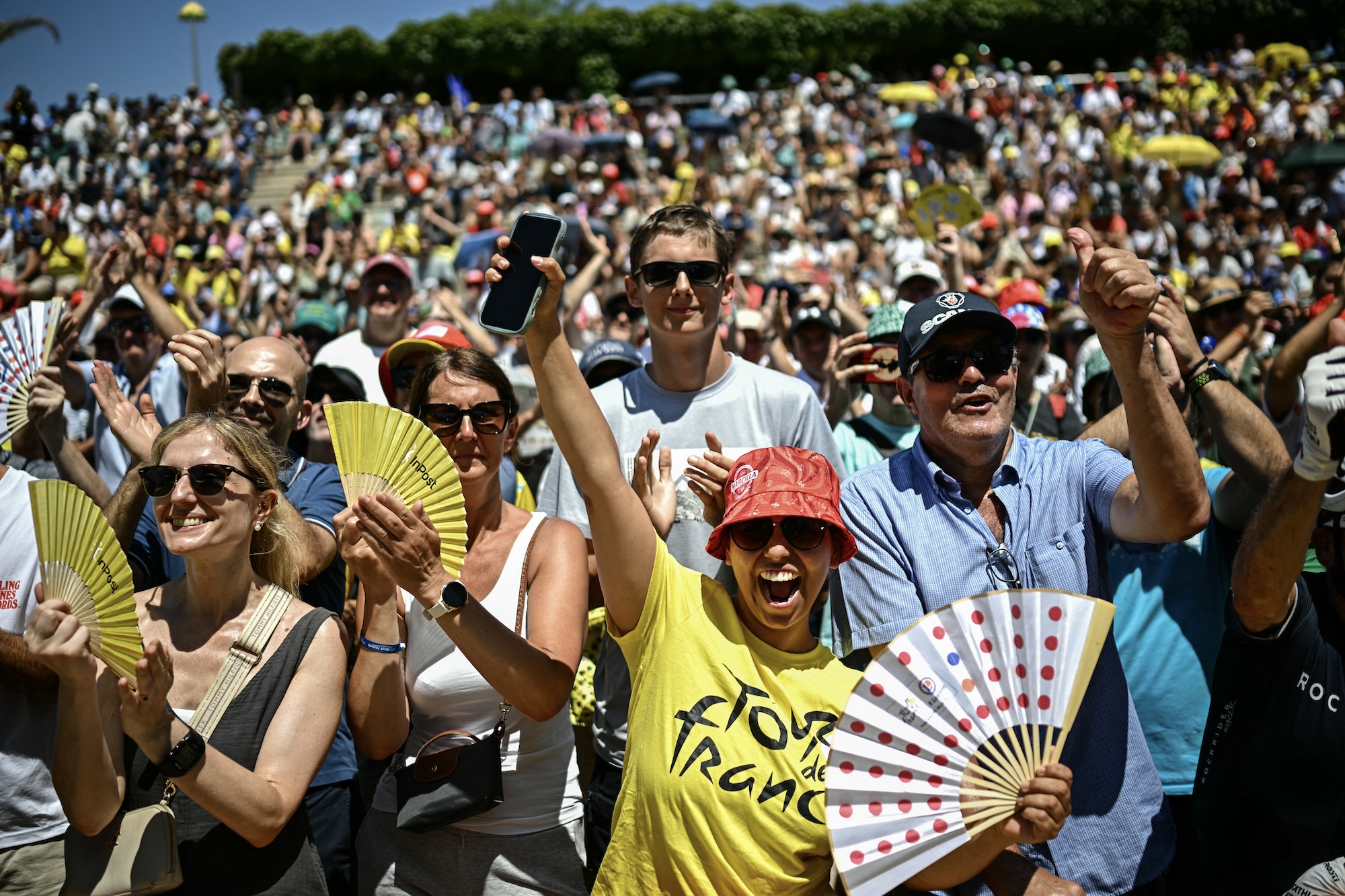
The Tour sells itself as a travelling democracy. You can stand on a roadside in thongs, with an esky, after walking up a goat track at dawn, and watch the best cyclists on Earth come past close enough to smell hot brake pads and fear. That is the deal. Wimbledon has gates. Formula 1 has corporate fencing. The Tour has people on mountains, sometimes too many, sometimes too drunk, often too close, but essential.
Take them away and the race becomes something colder. A broadcast product. A private procession. A Zwift event with helicopters. Nobody involved wants that, but Stage 3 is showing us how quickly the open-road romance can be revoked when the landscape itself says no.
The Tour has always treated geography as scenery. On Monday, geography gets a vote.
This is not anti-cycling. It is pro-reality.
Cyclists are brilliant at selective outrage. Tell a bloke his favourite climb is closed for roadworks and he becomes a constitutional lawyer. Tell a bunch ride the coffee stop has no oat milk and civilisation is finished. So yes, some fans will be filthy. Some will have booked rooms, hired vans, driven hours, built a holiday around watching the Tour hit France for the first time in this edition.
Bad luck. Honestly. If firefighters need roads clear, the roads are clear. If police and medical crews cannot be wasted on directing caravan floats and shepherding spectators while a wildfire chews through the department, the Tour gets smaller. That is not bureaucratic panic. That is adulthood.
The race is still scheduled to run its 195.9 kilometres from Granollers to Les Angles. It still has the Col de Toses, 9.3 kilometres at 6.5 percent, and then the Col du Calvaire and the drag up to Les Angles, 1.8 kilometres at 6.5 percent. On paper it is the first day where the general classification can stop shadowboxing and start bleeding. But the most important gradient is not on the profile. It is the incline from normal sport into climate-managed sport.

Australians should recognise this movie
This is where Australian cyclists should stop smirking at Europe’s late discovery of fire. We know what smoke does to a ride. We know what it is like to check air quality before tyre pressure. We know what it means when a summer event organiser says the route is fine, then the wind shifts, the temperature jumps, and suddenly the sensible option is cancellation. Bushfire season has already rewritten plenty of Australian outdoor sport. Cycling, because it is stubborn and romantic and full of people who think suffering is a personality, has been slower to admit the obvious.
But every club crit, gravel weekend, MTB enduro and charity ride in Australia should be watching this Tour decision closely. Not because Les Angles is the same as the Otways, the Adelaide Hills or the Blue Mountains. Because the principle is identical. If your event needs police, ambos, volunteers, road closures, local goodwill and access through fire-prone country, then your race is not independent from the emergency system. It is borrowing capacity from it.
- Have a serious heat and fire policy before the sponsor banners are printed.
- Treat emergency services as partners, not obstacles to your perfect route.
- Build alternate formats, shortened courses and cancellation triggers into the event from day one.
- Stop pretending spectators are harmless just because they are not racing.
- Communicate early, clearly and without the usual sport-manager waffle.
The caravan disappearing matters more than people think
The publicity caravan is ridiculous, wasteful, beloved and very French. It is also the perfect symbol of the Tour’s contradiction. The race likes to paint itself as a celebration of landscape, human effort and rural life, then sends a rolling marketing circus through that landscape chucking trinkets from branded vehicles. Most of us accept the hypocrisy because cycling runs on hypocrisy. We buy aero socks to ride to bakeries. We say we love nature while flying bikes across continents. We complain about car dependency from the back seat of a team car.
But when the caravan is pulled from the French portion so resources can focus on wildfire response, the curtain slips. Suddenly the spectacle is negotiable. Suddenly the race admits what should have been obvious: not every tradition deserves priority when the place hosting the tradition is under stress.
The peloton will race. The question is what kind of sport it becomes.
There will still be tactics. Visma will still try to make UAE uncomfortable. Pogacar will still look like he is attacking while reaching for a gel. Del Toro will probably ride as if someone wound him up with a socket wrench. The TV pictures may even be strangely beautiful, a quiet mountain finale without the usual wall of limbs and flags.
Do not mistake that beauty for normality. A Tour climb without fans is not purity. It is absence. It is the sound of the roadside being cleared because the people who normally make the race feel alive would be in the way. That should bother us. Not because the authorities are wrong, but because they are right.
Cycling loves to tell itself it is the clean sport because the machine is elegant and human-powered. That argument collapses the moment you zoom out from the rider to the convoy, the helicopters, the transfers, the sponsor activations, the fans driving up mountains, the merchandise, the endless need to turn roads and towns into content. The bicycle is efficient. The event around it often is not.
The answer is not to kill the Tour, calm down. The answer is to stop pretending the Tour can keep expanding its appetite while the places it visits become hotter, drier and more volatile. Smaller caravans. Smarter transport plans. Real public transport access. Fewer pointless vehicles. Harder cancellation rules. Less macho nonsense about racing through anything. That is not anti-spectacle. It is how spectacle survives.
If cycling wants to keep owning the road, it has to stop acting like the road owes it anything.
Monday’s stage might still be a cracker. It might launch the GC fight. It might show us whether Vingegaard’s yellow jersey is armour or just fabric. But whatever happens on the last ramp to Les Angles, the real message has already arrived. The Tour can no longer assume the mountain will be waiting, lined with fans and happy to play backdrop.
The mountain is hot. The firefighters are busy. The caravan has been told to stay away. For once, cycling is not the main character. It should pay attention.