
The Tour Down Under Finally Gave Women The Same Road. Now Comes The Bill.
Adelaide has just done what cycling loves pretending is impossible: same day, same route, same distance. Brilliant. Now the sport has to stop treating equality as a route announcement and start paying for the whole bloody thing.
On Tuesday 22 September 2026, while half the cycling internet was watching rainbow jerseys get rationed out in Montréal, the UCI quietly confirmed something far more useful than another governance press release: the 2027 Women’s WorldTour opens in Australia with a Santos Tour Down Under that finally stops making women’s racing feel like the support act setting up while the road barriers are still being unpacked.
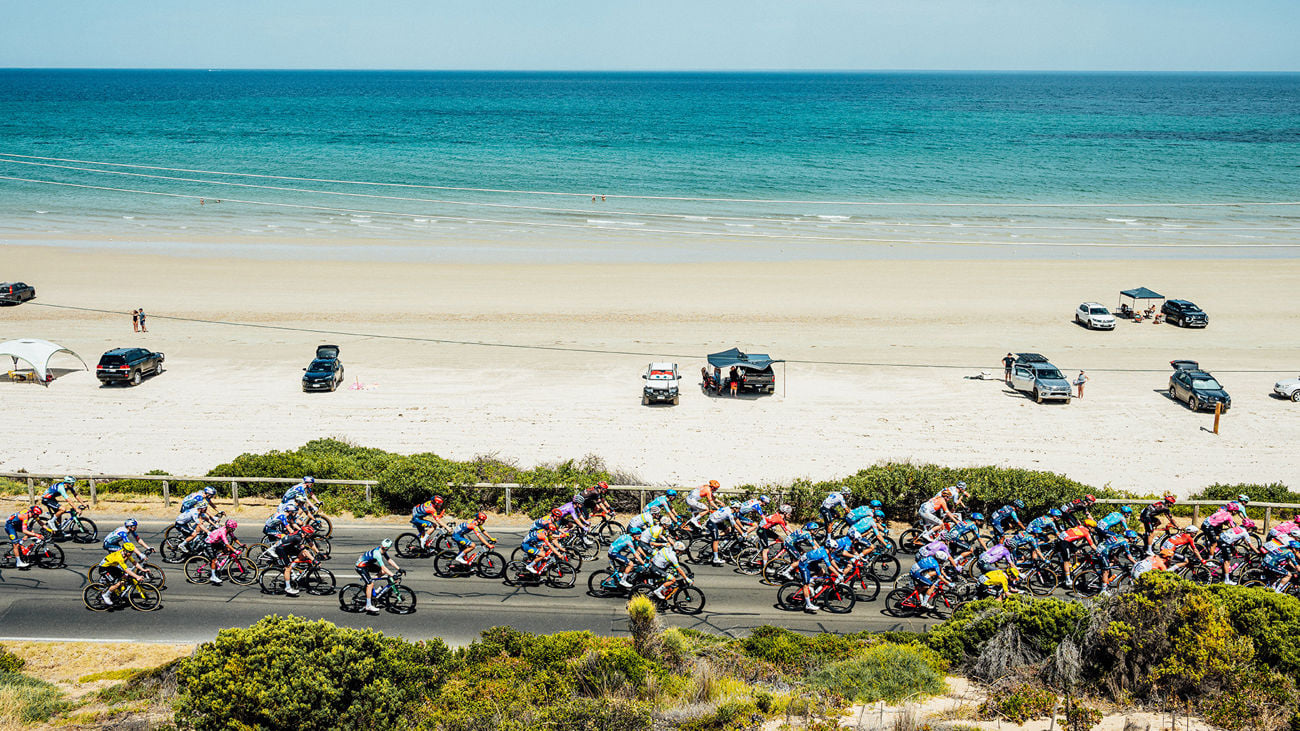
From Friday 22 January to Sunday 24 January 2027, the women’s Tour Down Under will run on the same course, on the same day and over the same distance as the men’s final three stages. That is not a cute symbolic lap around Adelaide. It is Glenelg to Victor Harbor at 144.7 kilometres. It is Christies Beach to Willunga Hill at 116 kilometres. It is Norwood to Stirling at 136 kilometres. In total, the women get 397.3 kilometres of WorldTour racing across three days, while the men’s six-stage race totals 876 kilometres from 19 to 24 January.
This is not tokenism. It is a course designer calling everyone’s bluff.
For years, cycling has hidden behind logistics whenever equal treatment comes up. Not enough daylight. Not enough police. Not enough motos. Not enough broadcast helicopters. Not enough anything, except apparently enough money for another VIP enclosure full of men in linen shirts explaining pathway development over warm sauvignon blanc.
Adelaide has now put a large, sunburnt South Australian boot through that argument. The 2027 format is not perfect, but it is a proper test case. Same route means no pretending the women need a softer race. Same day means no burying the result when everyone has gone home. Same distance means no patronising maths about what the peloton can handle. If the men are hitting Willunga twice, the women are hitting Willunga twice. If the final day is a messy, lumpy Adelaide Hills ambush, everyone gets the same ambush.
The beauty of this format is also the danger: once fans see the same road raced two different ways on the same afternoon, the excuses get very hard to sell.
This should make the racing better, not merely fairer. Women’s cycling is at its best when organisers stop shrinking the canvas. Give the peloton real distance, real climbs, and real tactical fatigue, and the race stops being a polite highlights package. It becomes a bike race with consequences. The Victor Harbor stage has four climbs, including Nettle Hill late enough to ruin sprinters and tempt the brave. Willunga is Willunga, which is to say it has made and broken careers with the subtlety of a cricket bat. Stirling is not a ceremonial roll-in either. It is the kind of stage where a rider can lose the race because she blinked in the wrong corner of the hills.
The broadcast had better not stuff this up
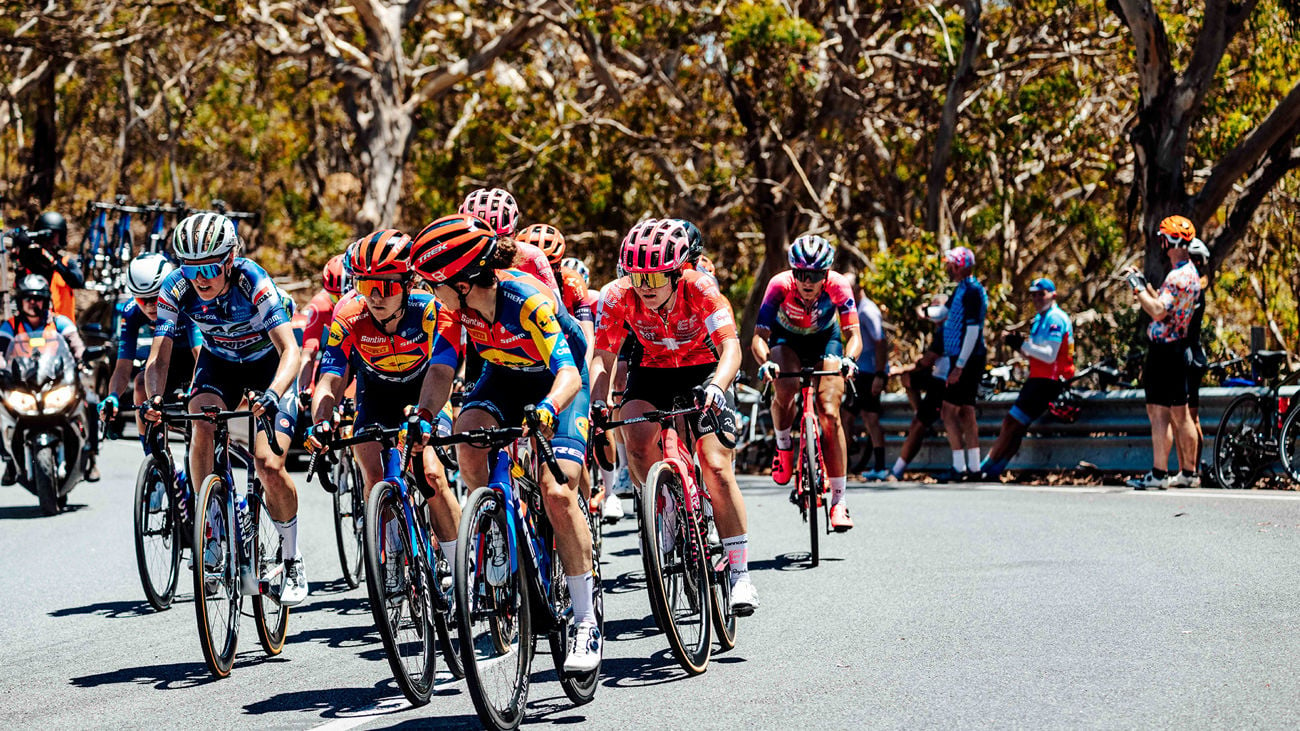
Here is where the champagne should stay on ice. Same route is the easy headline. Same respect is the difficult job. The men start 90 minutes ahead of the women on the overlapping days, which is operationally tidy but editorially dangerous. If the men’s race is still being dissected while the women are launching the move of the day, producers will be tempted to treat the second race as a convenient cutaway. That would be unforgivable.
Cycling already has a broadcast attention problem. Too many women’s races are presented like a postscript, with patchy pictures, fewer motos, weaker graphics and commentary that arrives wearing its homework on the bus. If South Australia wants this world-first format to matter, it needs full-race storytelling, not just finish-line respectability. Give viewers time gaps. Give them motorbike shots in the crosswinds. Give them domestic teams fighting for position before the climb. Give them the race, not a tasteful montage with a sponsor logo over the good bit.
- Separate tactical coverage for both races, not one race treated as the main feed and the other as bonus content.
- Equal seriousness in graphics, timing, post-race interviews and analysis.
- Proper roadside promotion so fans know they are getting two WorldTour races, not a men’s race plus an encore.
- Prize money, accommodation standards, team services and media access that match the rhetoric.
- Local pathways for Australian women to be visible, not merely present in the start list.
The Australian angle is bigger than Adelaide
Australia loves congratulating itself whenever the WorldTour starts here. Fair enough, too. The Tour Down Under has survived heat, politics, COVID interruption, calendar squeeze and the eternal threat of Europeans whingeing about the flight. But this 2027 shift is the first time in a while that Australia is not merely hosting the season opener. It is setting an agenda.
That matters because Australian cycling has a habit of producing serious women and then offering them a domestic ecosystem held together with cable ties. We celebrate the outliers who survive Europe, then act surprised when the pipeline looks thinner than it should. A January block with the Tour Down Under and the Cadel Evans Great Ocean Road Race can be more than a warm-weather inconvenience for European teams. It can be a home stage for Australian riders, mechanics, directors, photographers, soigneurs and junior girls standing on the roadside deciding whether this sport actually has room for them.
But only if the industry turns up. Bike brands will plaster equality language over campaign decks the second there is a peloton photo and a sunset. Fine. Then bring demo fleets for women who actually ride smaller frames. Bring neutral support that does not treat women’s equipment as an afterthought. Bring shop nights, mechanics’ clinics, junior rides and proper signings where the women are not scheduled at breakfast because the men got the pub slot.
Do not call it solved
The obvious criticism is that the women still race three stages while the men race six. That is true. The calendar pressure is real, and the change was partly driven by team feedback about reducing the amount of time women’s squads have to spend in Australia before the Cadel Evans race. Teams have budgets. Staff need sleep. Mechanics cannot rebuild half the season from a hotel car park because cycling wants a nice slogan.
Still, let us not confuse a clever compromise with the finish line. Three identical stages are better than three lesser ones, but they do not erase the broader imbalance. The men get a longer GC arc, more opportunities for storylines, more television hours, more sponsor exposure and more chances for a forgotten domestique to become the bloke everyone suddenly rates. Women’s cycling needs more of that boring, cumulative attention. Equality is not just matching the climb profile. It is matching the oxygen around the race.
And yet, this is exactly the sort of reform worth defending because it changes what fans expect. Once people watch the women rip over the same hills, through the same towns, in the same heat, the old reduced-course logic starts to look as shabby as it always was. The peloton did not need protection from Willunga. It needed access to it.
Adelaide just raised the price of excuses
The 2027 Tour Down Under will not fix women’s cycling by itself. No race can. But it does something beautifully awkward: it removes a favourite hiding place. Organisers elsewhere will now have to explain why Adelaide can manage same-day, same-route, same-distance WorldTour racing and they cannot. Some answers will be legitimate. Many will be lazy. Good. Let them squirm.
For Australian cycling, this is a rare chance to lead without waiting for Europe to bless the idea first. The job now is to make the execution as bold as the announcement. Pack the roads. Broadcast the tactics. Pay the athletes properly. Sell the race like it matters. Because if January comes and the women deliver the better show, and do not be shocked if they do, nobody gets to pretend it was an experiment.