
The Tour Closed The Roads. The Drivers Still Found The Riders.
Two Tour riders hit by cars on time trial day is not a freak footnote. It is the sport accidentally admitting what every commuter already knows.
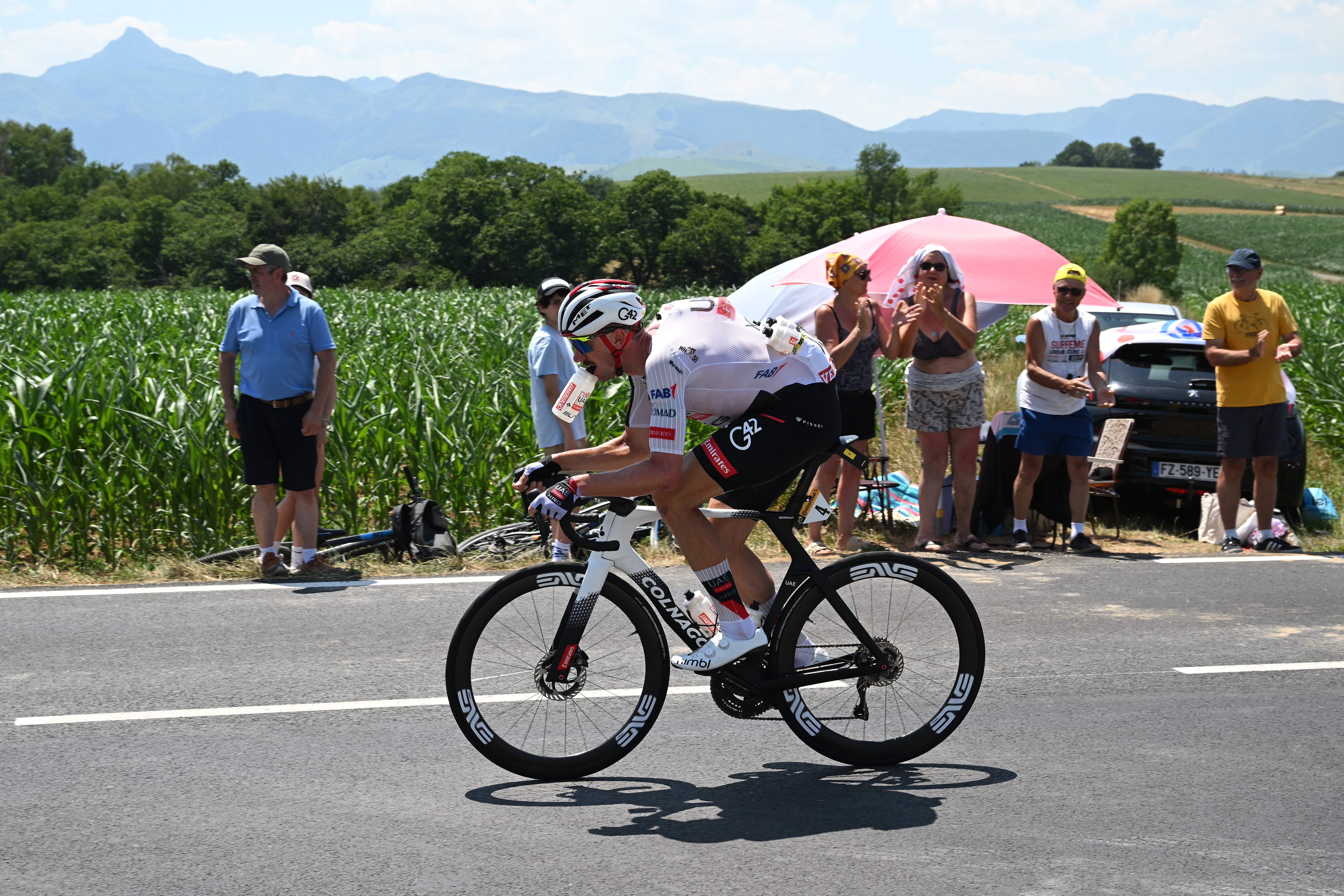
On Tuesday 21 July 2026, the Tour de France did what it does best. It built a temporary kingdom for bikes. Barriers, marshals, police, television motos, sponsor cars, timing chips, commissaires, helicopters, the lot. Inside that bubble, Remco Evenepoel flattened the 26.1km time trial from Évian-les-Bains to Thonon-les-Bains like a man trying to prove physics was underfunded.
Outside the bubble, the real world barged back in with a bonnet.
Brandon McNulty was hit by a car during his recon of the stage 16 course. Later, Xandro Meurisse, having finished his ride against the clock, was struck from behind while riding away from the finish area. Meurisse ended up with abrasions across his back, hip, elbow and knee, a shredded kit, a destroyed bike, and apparently no fractures. He was cleared to start stage 17. That last sentence will be treated as good news, because cycling has trained itself to file survival under good luck.
This was not a Tour incident. It was a cycling incident with better cameras.
The lazy take is to call this a weird Tour de France admin problem. Time trial day is messy, riders are everywhere, recon schedules are awkward, local traffic gets half-closed and half-confused, and everyone is trying to squeeze a Grand Tour through normal life. Fine. That is all true. It is also a dodge.
The sharper truth is uglier. Even at the biggest bike race in the world, with the sport’s most expensive logistics machine humming beside Lake Geneva, riders are still vulnerable the moment they leave the taped-off fantasy. The road closure ends and suddenly the athlete is not a protected professional. He is just another bloke on a bike being treated as movable furniture.
A closed race route is not a safety culture. It is a temporary fence around a sport that still has to ride home.
That is why this should land hard in Australia. We love borrowing the glamour of European road cycling, the tan lines, the espresso mythology, the unnecessary socks. But the moment the conversation turns to basic road respect, we get the same dreary talkback-radio slurry. Rego plates. Single file. Get on the path. Why are you wearing Lycra. Why are you in the lane. Why are you alive in my way.

The peloton gets sympathy. Commuters get blamed.
This is the bit cycling fans need to sit with. When a Tour rider is hit, we instinctively understand the violence of it. We know he is light, exposed and travelling on trust. We know a driver’s impatience can become blunt force in half a second. We see the torn skinsuit and nobody sensible says, actually, did he pay rego on the Pinarello?
But strip away the team bus and the race number, put the same rider in a faded club jersey on Plenty Road, Old Cleveland Road, Marmion Avenue or Parramatta Road, and suddenly half the country wants a courtroom drama about whether he should have been two centimetres further left.
Australia has minimum passing distance laws. In Queensland, NSW and Victoria, the familiar rule is one metre up to 60km/h and 1.5 metres above that. It is not a radical cycling wish list. It is the legal equivalent of saying do not hit the fragile person with your heavy thing. Yet every rider with a rear light and a memory card knows the gap between law and tarmac. The rule exists. The culture often does not.
Race organisers cannot wash their hands at the finish line
The Tour will not like this, but recon, warm-up, cool-down and transfer riding are part of the event. They are not private little errands that magically become the rider’s problem once the sponsor arch is behind them. If riders are expected, encouraged or simply allowed to pedal back to hotels or buses through live traffic during a Grand Tour, then the organiser has a duty to treat that movement as operational risk.
That does not mean every rider gets a police escort to the bakery. It means proper protected transfer corridors where possible, clearer post-finish traffic control, neutral shuttle options that teams actually use, and consequences for drivers who treat a collision with a cyclist as slapstick. If a fan can get within selfie distance of a Tour rider, and a car can get within impact distance of one 90 minutes later, the system is not as polished as the helicopter shots suggest.
- Treat recon and post-stage ride-backs as part of race safety planning, not rider lifestyle choices.
- Publish clear traffic protocols for time trial days, especially around starts, finishes and team hotels.
- Make driver accountability visible when riders are hit, because silence teaches the next idiot that nothing happens.
- Stop pretending road safety is only a grassroots commuting issue when the WorldTour keeps proving otherwise.
Teams deserve some heat too. Pro cycling still has a macho little romance with riders spinning back from the finish, legs open, head clearing, mechanic waiting with the spare bike. Lovely. Also, occasionally stupid. If your rider has just emptied himself in a Tour time trial and the roads around the course are full of confused locals, sponsors, fans, media vans and people staring at phones, maybe the romance can sit in the team bus with an electrolyte drink.
The Tour is a mirror, not an exception
This is where the column stops being about McNulty and Meurisse and starts being about us. The same hierarchy applies on Beach Road at 6:30am, on a Perth bunch ride rolling home into a sea breeze, on a gravel link road outside Nannup, and on a delivery rider’s night shift in Brisbane. The person with the engine thinks the person without one is negotiable. The cyclist plans escape routes. The driver plans arrival time.
Cycling keeps selling itself as freedom. The open road, the clean line, the private rebellion of going somewhere under your own steam. But freedom with a car sitting ten centimetres off your elbow is not freedom. It is probation.
The Tour de France can close half a mountain, flood a lakeside town with police, and make the world stop for one rider every two minutes. Still, on the same day, two professionals were reminded that the most dangerous part of cycling is often not speed, corners, carbon rims, descents, rain, tactics or fatigue. It is the ordinary driver who cannot wait, cannot pass, cannot see, or cannot accept that a bike belongs on the road.
So yes, watch stage 17. Argue about the sprint. Enjoy the circus. But do not let the Tour package this away as bad luck on a busy day. Bad luck is a puncture. Being hit from behind by a car is culture made physical. If cycling’s grandest race cannot keep that truth outside the barriers, the rest of us should stop pretending our Saturday bunch ride is somehow being dramatic.