

The Nationals Course Got Moved To A Horse Track. That Is The Real Scandal.
Junior and Masters Road Nationals will go ahead on the Sunshine Coast, but the late move from Yandina to Corbould Park says the quiet bit loudly. Australia wants champions, just not the inconvenience of racing bikes on roads.
While Europe is busy hyperventilating about Enric Mas finally dragging Movistar out of its long tactical swamp and Montréal is polishing the furniture for Road Worlds, Australian cycling has managed to produce a more honest little crisis. Not glamorous. Not global. Not the sort of thing that gets a slow-motion helicopter shot. But more revealing than most of the WorldTour theatre.
AusCycling has confirmed the 2026 Junior and Masters Road National Championships will still run on the Sunshine Coast from 17 to 20 September. Good. Cancelling age-category nationals a week out would have been unforgivable for families who have paid for flights, accommodation, time off work, taper weeks, junior coaching plans and the thousand tiny humiliations that come with trying to race bikes seriously in Australia.
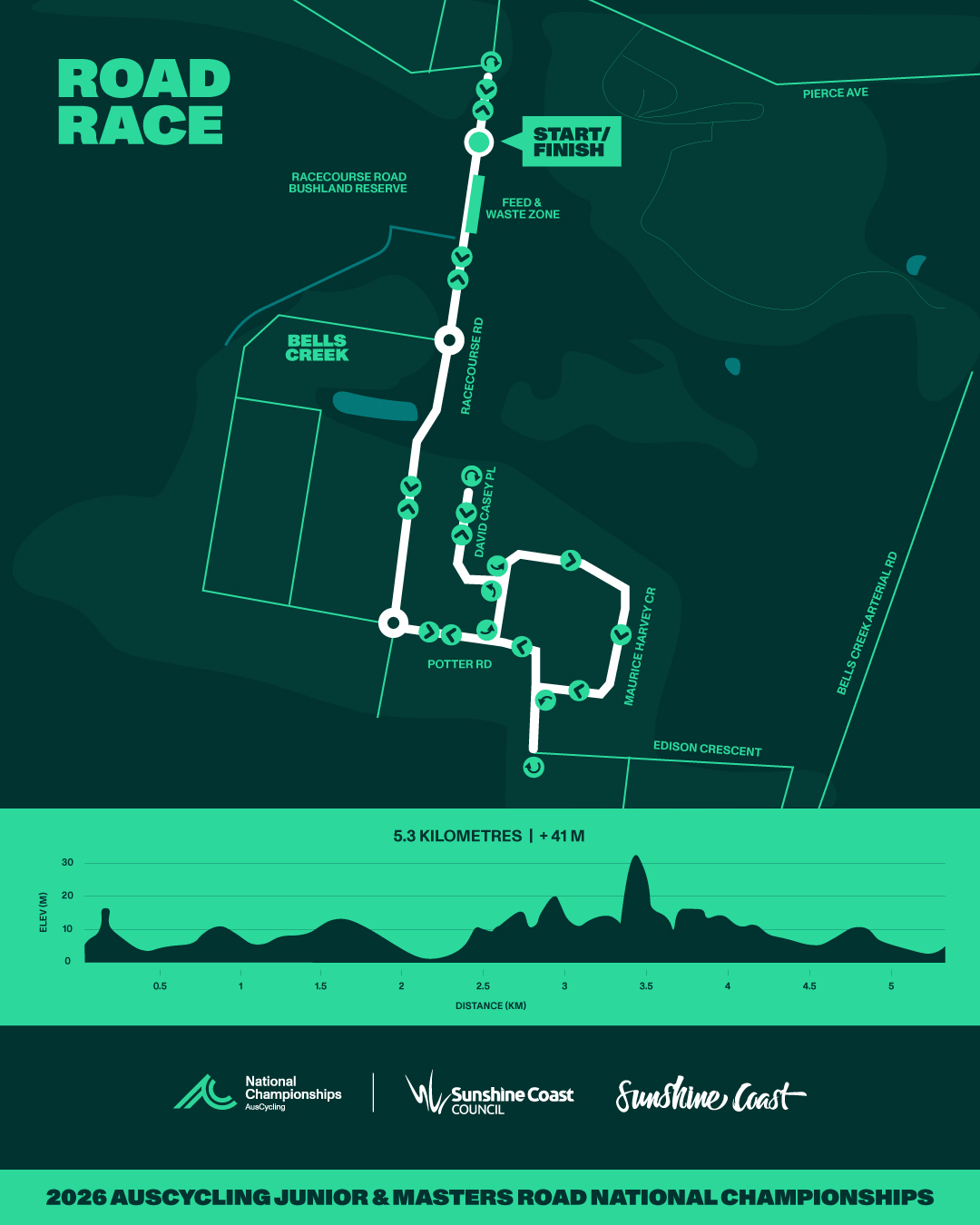
But the road race has been shifted to a revised circuit around the Corbould Park precinct after the originally planned Yandina course could not secure the required approval following community concern over road closures and traffic management. Translation, in café language: the race survived, but the road race got shoved somewhere easier to contain.
This is not just a course change
The new format spreads the championships across three locations. The time trial stays in Yandina on Thursday 17 September. The criterium runs at Girraween on Friday and Saturday. The road races land at Corbould Park on Saturday and Sunday. On paper, that is tidy event management. In practice, it is a map of Australian cycling’s political weakness.
The new road circuit is 5.3 kilometres with 41 metres of elevation per lap. It wriggles around Racecourse Road, Potter Road, David Casey Place and Maurice Harvey Crescent. It is not a grand old road course. It is not a hinterland war of attrition. It is not the sort of terrain that lets a rangy diesel climb out of the saddle and break hearts in the heat. It is a short, technical, repeat-hit circuit built from the pieces still available once public tolerance has taken the good roads off the table.
A national championship should be hard to win. It should not be this hard to host.
Let’s be clear before the Facebook dads start clearing their throats. AusCycling did the right thing by finding a way to keep the event alive. If there were genuine concerns about traffic management, resident behaviour or threats to riders and volunteers, you do not bluff your way through that with a roll of bunting and a police escort. Nobody needs a junior road title decided by whether a furious local in a dual-cab decides the race convoy has personally stolen his Saturday.
The problem is not Corbould Park. The problem is why Corbould Park became the answer.
AusCycling’s pathway people are already selling the course as technical, nervous, corner-heavy and useful for riders who may one day face the compressed violence of Belgian, Dutch and French racing. They are not wrong. Juniors need to learn bunch craft. Masters need to be punished for thinking threshold intervals are a personality. Repeated accelerations out of corners will sort plenty of riders who look heroic on a four-lane climb and useless when a race starts bending every 300 metres.
There will be good racing. Probably very good racing. A small circuit makes selection harder to hide. Position will matter. Bad cornering will get taxed. Lazy riders will yo-yo until their quads start filing workplace complaints. The winners will deserve the jerseys.
Still, do not let the spin become the story. This is a national road championship for juniors and masters, not a Tuesday night business-park crit with a better announcer. The fact that a recognised road racing course around Yandina could be planned for months, then effectively lost to approval and community pressure this late, should make every club, promoter and state body in the country sit up straight.
Australia keeps producing riders from a racing system it refuses to protect
This is the contradiction. We love pointing at the export product. Grace Brown. Jai Hindley. Ben O’Connor. Michael Matthews. Ruby Roseman-Gannon. Luke Plapp. Sarah Gigante. The Olympic medallists, the WorldTour graft, the kids disappearing to Europe because the race calendar there still understands that bicycles are meant to contest public space.
Then at home, when juniors and masters need a national title course, we act as if closing a handful of roads for a few hours is an exotic imposition. We can shut whole suburbs for fun runs, triathlons, markets, car festivals and football traffic. We can accept endless roadworks with a shrug. But tell motorists their shortcut is unavailable because 15-year-olds and 55-year-olds are racing for a green-and-gold jersey and suddenly the republic is under attack.
- Road racing has lost ordinary civic legitimacy in too many Australian places.
- Councils like the prestige of hosting events more than the heat of defending closures.
- Families are carrying the risk when event certainty collapses late.
- Technical precinct racing is useful, but it cannot replace proper road racing.
- If volunteers are facing hostility, the sport has a social licence problem, not just a traffic problem.
The most irritating part is that the host region will still get to call itself a cycling destination. There will be banners, smiling councillors, tourism language about active lifestyles and probably a few drone clips if the weather behaves. But a cycling destination that cannot defend road racing on actual roads is not a cycling destination. It is a scenic background with conditional approval.
The juniors are watching
The junior riders will learn something this week. Not just how to surf wheels through a technical circuit, but how their sport is valued. They will see parents refreshing updates, coaches reworking plans, clubs scrambling, volunteers absorbing stress, and officials trying to keep the ship afloat while everyone pretends this is merely an operational wrinkle.
That matters. A junior national championship is not a novelty event. It is where a young rider first feels the difference between being quick and being serious. It is where families decide whether the sport is worth another year of motel rooms, early starts and destroyed weekends. It is where a kid from a small club can look across the start line and think, yes, this is real.
Make that experience unstable enough and the talent does not vanish dramatically. It just leaks. A promising rider chooses footy. A parent stops driving. A club loses its sharpest under-17. A master who volunteers at everything finally says stuff it. By the time AusCycling notices the hole, everyone will be in a meeting using the word participation like it is a spell.
Stop pretending this is only about angry locals
Cyclists love blaming drivers. Often, fair enough. Some people react to a road closure as if the United Nations has seized their driveway. But the sport also needs to be honest about its own job. If communities only hear about bike racing when a letterbox notice arrives telling them access will change, we have already lost. If councils are surprised by backlash, they have not done the politics early enough. If residents can intimidate an event out of a course, the safety plan has failed before the commissaire’s car rolls.
The fix is not another glossy strategy document. It is boring, local and relentless. Clubs need relationships with councils before they need permits. Councils need to defend bike racing as legitimate public use, not a favour granted to lycra weirdos. AusCycling needs a national playbook for road closures that does not leave every organiser reinventing the wheel with different police, different councils and different local outrage merchants.
And cyclists need to stop treating the calendar like weather. Events do not simply happen. Courses are political objects. Every corner, marshal point and traffic detour is a negotiation with people who may not care if the next Australian WorldTour rider gets their first taste of hard racing on a proper road.
So yes, race Corbould Park hard. Attack out of the corners. Make the course look better than it has any right to. Let the best juniors and masters earn their green-and-gold jerseys properly. But after the medals are handed out, do not file this away as a saved event and move on.
The uncomfortable lesson of the Sunshine Coast is simple. Australian cycling is still good at producing riders despite the system, not because the system is strong. A sport that wants champions has to win the argument for taking up space. Not on Instagram. Not in a high-performance plan. On actual roads, in actual towns, before the angry emails start.