
Queensland Put A Licence On The E-Bike. The Car Won.
From Monday, Queensland will make legal e-bike riders carry a driver licence. That is not safety policy, it is car culture in a hi-vis vest.
On Monday, 31 August 2026, Queensland will do something wonderfully stupid. It will take a legal pedal-assist bicycle, the sort capped at 250 watts and 25 km/h, and tell many riders they now need a driver licence to use it in public. Not registration. Not insurance. Not a motorbike plate. A driver licence, for a bicycle whose motor cuts out at the speed plenty of fit club riders hold while arguing about tyre pressure. (qld.gov.au)
This is not a fringe by-law hiding in a council PDF. Queensland’s own rule page says the new age and licensing rules apply from 31 August 2026, and that a rider must be 16 and hold at least a learner licence to ride an e-bike, with exemptions for some under-16s under supervision, designated recreational areas, and medical or disability cases. (qld.gov.au) It is dressed up as safety. It smells like panic.
The problem was illegal e-motos. The punishment lands on bicycles.
Let’s be precise, because this debate gets poisoned by sloppy language. A legal e-bike in Queensland must be pedal powered, limited to 250 watts of continuous rated motor output, provide assistance only up to 25 km/h, and use throttle only up to 6 km/h to help start moving. Petrol-powered bikes, throttle machines that do not need pedalling, and overpowered electric bikes are already illegal on public roads and paths. (qld.gov.au)
That distinction matters. A step-through commuter bike helping a nurse get up a Brisbane hill after night shift is not the same thing as a 1000-watt stealth dirt bike being flogged down a shared path by a kid with no helmet. One is active transport. The other is an unregistered electric motorbike pretending to be a bicycle because the importer, retailer and enforcement system all looked the other way until the complaints became politically useful.
Queensland has not drawn a bright line between bikes and illegal motorbikes. It has drawn a police tape line across the bike path and asked ordinary riders to produce car paperwork.
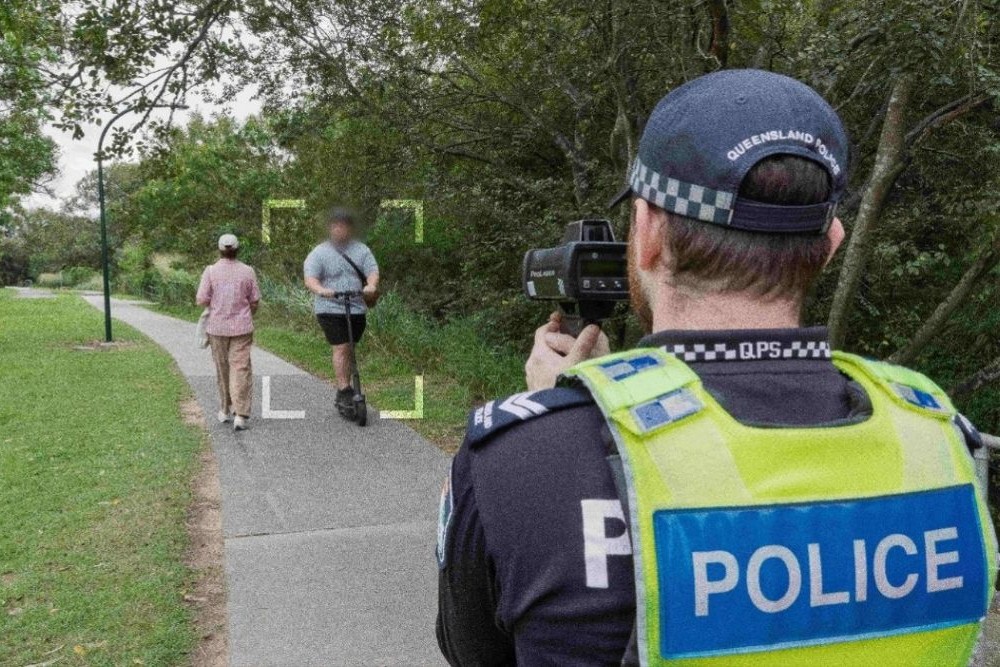
The state has already given police sharp tools. From 1 July 2026, Queensland Police gained powers to seize and destroy illegal devices, conduct roadside breath testing, enforce a 0.05 blood alcohol limit, and apply a 12 km/h limit on footpaths and when passing pedestrians on shared paths. In the first month of Operation Yankee Surety, police issued 991 infringement notices, seized 249 non-compliant devices, conducted 331 roadside breath tests, and charged 24 riders with drink riding offences. (qld.gov.au)

A learner licence is the wrong tool for the job
Here is the absurdity. A driver licence tells the state you have passed a test to operate a car on roads. It does not prove you can ride predictably on a shared path. It does not teach a teenager how to pass a pedestrian politely. It does not stop a dodgy online seller from shipping an unlocked throttle missile. It does not help a retiree who gave up driving years ago but still rides a compliant e-bike to the shops.
Queensland’s own exemptions reveal the flaw. If people with medical conditions or disabilities need a pathway to keep riding, that is not an edge case, it is evidence that e-bikes are mobility devices as much as recreational toys. The state says those riders may need a signed exemption form from a health professional and must carry it while riding. (qld.gov.au) Imagine designing transport policy so the person doing the least harm has to carry paperwork, while the bloke in a two-tonne ute rolls past unexamined because he once parallel parked well enough.
- Retailers and online marketplaces selling non-compliant throttle bikes as e-bikes.
- Importers advertising unlockable high-power motors for public use.
- Parents buying electric motorbikes for kids and pretending pedals make them legal.
- Dangerous riding behaviour, including speed near pedestrians, no helmets, phone use and carrying passengers on bikes not designed for it.
- Infrastructure failure, because mixing walkers, dogs, prams, scooters, cargo bikes and commuters on narrow paths is not a behavioural problem, it is design negligence.
To be fair, the federal government has finally noticed the sales channel problem. On 6 August 2026, it directed the ACCC to develop a nationally consistent safety standard for e-bikes and e-micromobility devices under Australian Consumer Law, building on transport ministers’ move to adopt EN 15194 as guidance for what belongs on Australian roads. (minister.infrastructure.gov.au) That is the grown-up part of the response. Regulate the product before it reaches the footpath. Make the seller responsible. Stop pretending the consumer can decode wattage, continuous output, throttle cut-offs, compliance labels and state-by-state carve-outs while standing in a warehouse sale.
The bike industry should not hide behind outrage
The cycling industry has a habit of discovering principles only after the compliance bill arrives. Some shops did the right thing, sold proper EPACs, explained 25 km/h cut-outs, and refused the dodgy stuff. Others took the cash, winked at unlock modes, and let the category rot. Online sellers were worse. If you sold a 750-watt throttle bike to a parent and called it school transport, you helped write Queensland’s law for them.
But policy still has to be proportionate. NSW has gone hard too, with seizure and crushing powers for illegal e-bikes and a plan to use roadside dyno units to test whether bikes can exceed the 25 km/h limit. (nsw.gov.au) There is a sensible version of that, aimed at genuine illegal motor vehicles. There is also a performative version, where police theatre replaces product regulation, road design and actual cycling literacy.
Cyclists should care, even if they ride acoustic bikes
If you ride a carbon road bike, do not smirk. The political class that cannot tell a legal e-bike from an electric dirt bike will not suddenly become nuanced when it talks about bunch rides, gravel bikes on fire trails, kids riding to school, or commuters taking the lane. Bad regulation spreads. It starts with a category the public finds annoying, then hardens into a general suspicion of anyone not sitting behind a windscreen.
The honest safety case is simple. Illegal electric motorbikes should be off shared paths. Riders who hammer past pedestrians at stupid speeds should be fined. Drunk riding should have consequences. Kids should not be handed high-powered machines and sent into traffic. But requiring a driver licence for compliant pedal-assist e-bikes is not precision. It is a dragnet.
Queensland had a chance to separate bikes from motorbikes, transport from toys, and enforcement from culture war. Instead, it has made the car licence the passport to low-carbon mobility. That is the giveaway. The state does not really understand e-bikes as bicycles with assistance. It understands them as tiny cars that have not yet been humbled by paperwork.
So yes, crush the illegal throttle rockets. Fine the idiots. Chase the sellers. Make compliance labels mean something. But do not tell Australia that a legal e-bike rider needs proof they can drive a Corolla before they can pedal to work. That is not road safety. That is the car winning another argument it should never have been allowed to enter.