
Montreal’s Road Workers Just Found Cycling’s Real Pressure Point
The 2026 Road Worlds are not in danger because of cobbles, climbs or another Belgian ego summit. They are vulnerable because cycling keeps pretending the city beneath the race is just scenery.
Here is the cycling story that should be making every race organiser in the world sweat through their gilet: Montreal’s blue-collar municipal workers have filed notice for possible strike action during the 2026 UCI Road World Championships.
Not a rider boycott. Not a tyre-pressure scandal. Not another national coach trying to explain why Wout van Aert and Remco Evenepoel can share a room without turning it into a Flemish constitutional crisis. Actual workers. The people who make a city function before the helicopter shot arrives and pretends cycling created civilisation.
The Syndicat des cols bleus regroupés de Montréal, SCFP 301, has lodged notice for seven days of action from 22 to 28 September, running 6am to 6pm, while negotiations with the city continue. Essential services are expected to be maintained, but let us not kid ourselves. A Road Worlds is basically a week-long argument with urban logistics. Fencing, road closures, towing, resurfacing, rubbish, signage, barriers, emergency access, public toilets, crowd control, detours, breakdowns, all of it. Strip away the municipal muscle and suddenly the rainbow jersey looks less like sporting mythology and more like a very expensive inconvenience in Lycra.
The road race is not the hard bit. The city is.
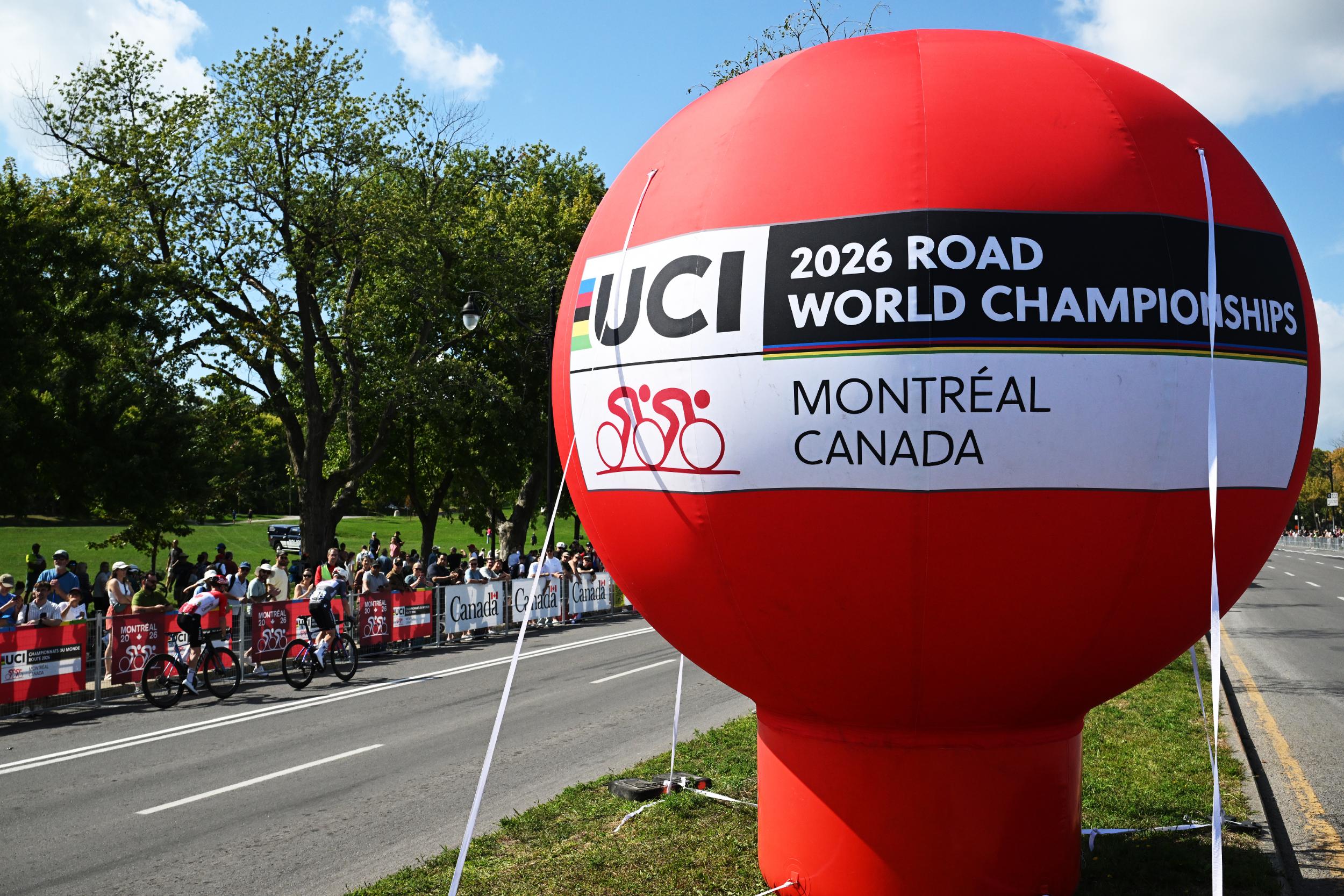
Montreal is not hosting a criterium in a business park. The city’s own public information says the Worlds will run from 19 to 27 September, with 13 events across multiple streets in seven boroughs and Westmount. Traffic and parking will be significantly affected. Fences go in at 7am on race days. The main site at the foot of Mount Royal, on Avenue du Parc between Avenue des Pins and Avenue du Mont-Royal, is closed to vehicles from 4 September until 4 October because the race village does not build and unbuild itself by magic.
This is where cycling’s self-image starts to wobble. We love to talk as if the sport is pure, lightweight and nimble. A peloton floating through public space. Wheels hissing over tarmac. National colours. Cowbells. Someone dressed as a devil who should have been retired by committee in 1998. But the modern mega-event is heavy. It lands on a city with trucks, fencing, police rosters, contractors, hotel pressure, public complaints and overtime sheets.
A World Championships is not just a bike race. It is a temporary occupation of civic space, and the locals are allowed to ask who is paying for the privilege.
Cycling does not like that sentence because cycling prefers romance. It wants Mount Royal to be a cathedral and the workers to be invisible. Sweep the road, close the intersection, move the car, fix the barrier, smile for the broadcast, then please vanish before the drone rises. That attitude is not just arrogant. It is amateur.
Mount Royal will choose a champion, but city labour will decide whether the show works
The course itself is magnificent. The elite men are listed for 273.7km and 3,803 metres of climbing. The elite women get 180.4km and 2,570 metres. The final Mont Royal circuit is 13.4km with 269 metres of elevation each lap, repeated 12 times by the men and eight by the women. Camillien-Houde bites early, Polytechnique kicks over 11 percent, and Avenue du Parc drags to the finish with the slow cruelty of a café ride where the old bloke in faded kit refuses to sit up.
Good. Worlds should hurt. A rainbow jersey should not be won by the rider who best survives a nervous four-lane funnel and a late roundabout. Montreal gives cycling something it badly needs, an urban course with rhythm, repetition and consequence. It is familiar enough from the Grand Prix Cycliste de Montréal to have credibility, but hard enough to shred teams that arrive with eight riders and one idea.

But that is precisely the point. The harder, denser and more photogenic the course, the more it depends on the people cycling usually edits out. Every barricade on Camillien-Houde has a person behind it. Every closed street has a resident arguing about access. Every resurfaced corner has a crew whose work will be praised by nobody unless it fails. This is not background noise. This is the race.
Do not sneer at the strike notice
The laziest response is already warming up in the bunch: why now, why during Worlds, why disrupt sport? Spare me. That is the entire point of industrial leverage. Nobody notices the people who hold the event together until they threaten to stop holding it together. Then suddenly everyone discovers a deep personal commitment to continuity.
If the union’s complaint is that the city is offering wage increases below inflation, then cycling fans might try something radical and imagine the worker’s side before reaching for the organiser’s press release. The sport is full of people who can recite a rider’s contract value from a dodgy transfer rumour but go strangely quiet when a road crew wants pay that does not go backwards. Funny, that.
- Cycling sells public roads as a free theatre, then acts surprised when the public has demands.
- The UCI loves host-city glamour, but the glamour is built by municipal labour, not blazer committees.
- Race safety is not only barriers and GPS trackers. It is road surface, access planning, emergency routes and workers who know the city.
- The economic benefits of major events are always advertised loudly. The disruption is usually explained quietly, after the contract is signed.
Australia should be paying attention. We did Wollongong in 2022 and know the drill: great crowds, glorious pictures, local pride, and a thick layer of residents wondering why their street had become a UCI spreadsheet. Brisbane 2032 will bring even more of this event logic. Every sport will promise legacy. Every government will promise activation. Every resident will be told to be patient while someone else monetises inconvenience.
Cycling, of all sports, should be smarter. Our entire daily existence depends on negotiating public space. We are the people who complain when councils build useless bike lanes, when drivers treat roads as private property, when tradies park in the painted strip, when governments discover active transport only for election brochures. So when a city workforce says, hang on, our labour matters here, cyclists should not default to the event-owner mindset.
The UCI can polish the rainbow. It cannot outsource legitimacy.
This comes at an awkward moment for the UCI. Just days ago it was talking tougher on race safety, including safer barriers from 2027 and more urgency around rider tracking after recent tragedies. Fine. About time. But safety culture cannot stop at the edge of the finish straight. A race that relies on a stressed city, underpaid workers, patched roads and last-minute civic goodwill is not a safe race. It is a gamble with branding.
Montreal still has time. Negotiations may settle. The strike may not happen. The Worlds may roll on beautifully, with the peloton hammering up Mount Royal while the broadcast tells us, for the 400th time, that Eddy Merckx won here in 1974. I hope it does. This course deserves a race. The fans deserve a spectacle. The riders deserve a Worlds that does not dissolve into municipal farce.
But if cycling learns nothing except how to issue a smoother stakeholder statement, it will have missed the lesson. Host cities are not neutral décor. Public workers are not props. Roads are not just race furniture. They are maintained, cleaned, closed and reopened by people with wages, contracts and leverage.
The peloton can float over Montreal all it likes. The race still belongs to the ground crew. And right now, the ground crew has everyone’s wheel.