
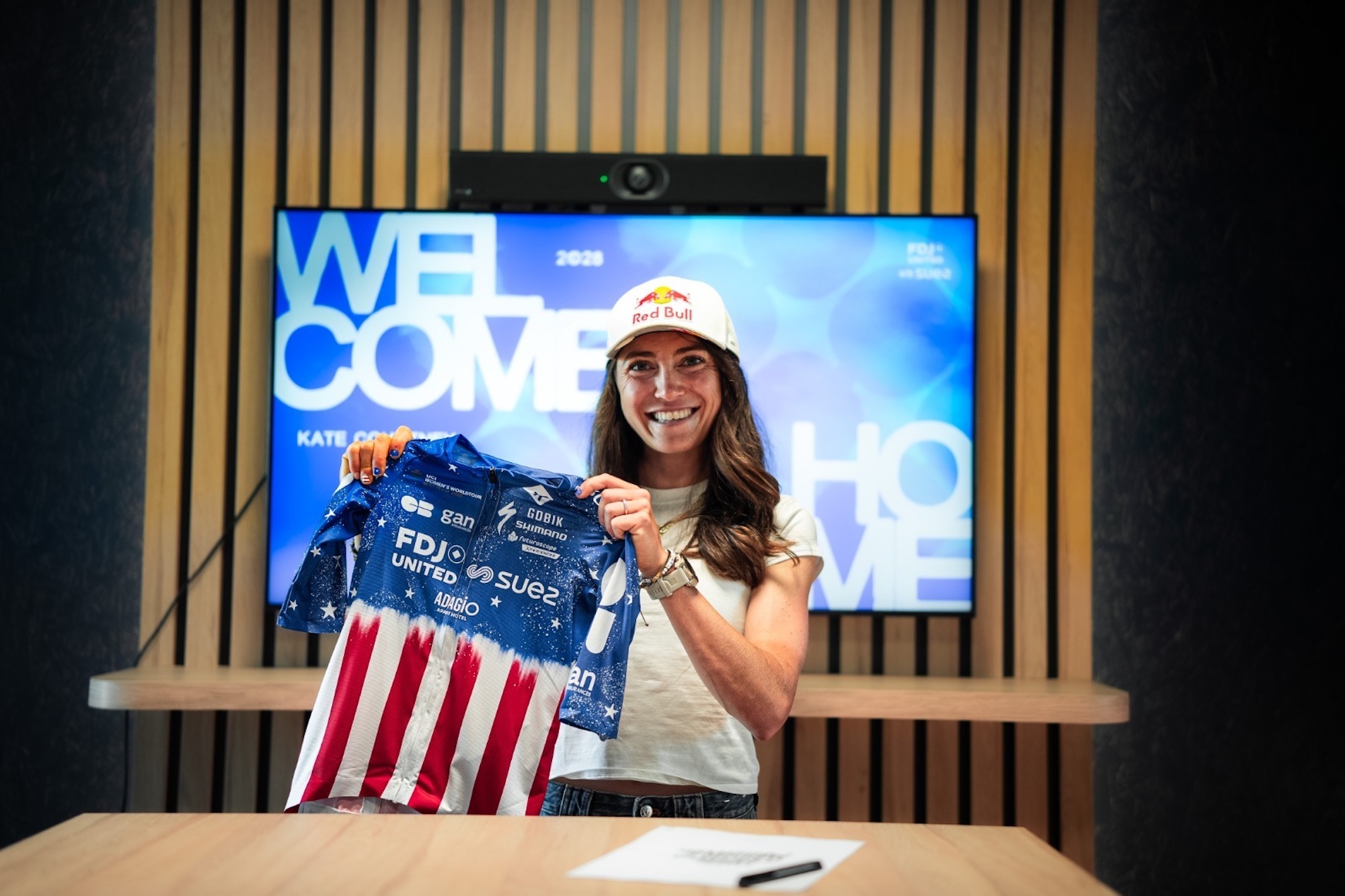
Kate Courtney Just Took Road Cycling’s Nicest Lie Out The Back And Dropped It
A mountain biker walking into the Women’s WorldTour should not be treated like a novelty act. It should terrify every roadie who still thinks bike handling is a decorative skill.
Kate Courtney joining FDJ United-SUEZ is the sort of move road cycling loves to call surprising because road cycling has a memory like a punctured tubeless insert. A rider from mountain biking and gravel wins the US road title, signs a deal through the end of 2028, pulls on a Women’s WorldTour jersey and makes her debut at La Périgord Ladies on Saturday 18 July. The road world gawps, as if a person who can ride full gas on dirt, handle chaos, read grip and suffer alone for hours might somehow be qualified to ride a bicycle on bitumen.
This is not a cute crossover story. It is not a sponsor activation with a Red Bull cap and a nice Instagram caption. It is a quiet humiliation of the old road pathway, the one that still pretends every great bike racer must be manufactured through juniors, development squads, under-23 road calendars and the sacred art of staring at a stem while a directeur sportif yells in four languages. Courtney has come through the side door, muddy shoes and all, and the room suddenly looks under-ventilated.
Road racing keeps rediscovering bike riders
Courtney is not a random athlete being handed a contract because someone in marketing found the word “multidiscipline” in a brand deck. She was the 2018 cross-country MTB world champion, the 2019 overall UCI Cross-country World Cup winner, and the 2025 marathon MTB world champion. This year she turned up at the Tour de Feminin, her first road race since she was 16, and won a stage. Then she went to the US road nationals in Charleston and outsprinted Lauren Stephens for the elite title. That is not dabbling. That is kicking the door open, taking the good biscuits and asking why the furniture is arranged so badly.
The peloton does not need more riders who can produce 5.8 watts per kilo in a lab. It needs more riders who can think while their tyres are complaining.
Her first weekend is properly cheeky, La Périgord Ladies today, Picto-Charentaise tomorrow, then the Lloyds Tour of Britain Women in August. That Britain start is pencilled in just four days after Leadville Trail 100 MTB, a race Courtney won last year. Most road teams would treat that calendar collision like a paperwork error. Courtney’s whole point is that the old boxes are too small. Road, gravel, MTB, marathon, stage racing, one-day punch-ups, they are not separate planets. They are different dialects of the same ugly language: keep pedalling when your brain starts bargaining.
FDJ United-SUEZ have bought more than legs
FDJ United-SUEZ already have star power with Demi Vollering and a team identity built around aggression rather than polite attendance. Courtney fits because she brings something road teams keep pretending they can coach in a winter camp: instinct. Mountain bikers make hundreds of micro-decisions a minute. Line choice, surface change, braking point, body position, whether to stay seated when every sensible tendon says stand. Road racing at WorldTour level is supposedly more controlled, but watch any nervous women’s classic in crosswinds, furniture, traffic islands and wet corners, then tell me the peloton could not use more riders raised on consequence.

Australians should be paying attention here. AusCycling has named Rebecca Henderson to headline the ARA Australian Cycling Team for the 2026 UCI Mountain Bike World Championships in Val di Sole from 26 to 30 August. Henderson is 34, a 13-time elite national XCO champion, and heading to her 12th elite MTB Worlds. The same announcement noted no Australian elite men satisfied the selection criteria, including mandatory event requirements. That last bit should sting. We are a country full of riders who can talk all afternoon about gravel tyre pressure, trail networks and bunch etiquette, but elite pathways still wobble when they have to connect domestic dirt talent to the global pointy end.
Courtney’s move should not be read as MTB losing a rider to road. That is the bitter little framing used by people who think disciplines are private property. It is better than that. It is proof that the best cyclists are becoming harder to categorise, and that the smartest teams will recruit for range, not résumé neatness. FDJ did not just sign a climber. They signed a rider who knows how to race without a train, how to survive when traction is theoretical, how to win from confusion.
The gravel lesson roadies refuse to learn
Gravel has been banging this drum for years, often while wearing regrettable hats. The best gravel racers are not just diesel engines. They manage equipment, nutrition, weather, isolation, group politics and surfaces that change mid-corner. Mountain biking adds another layer again because the penalty for arrogance is usually immediate and sometimes medical. Road cycling borrowed the sock height and the tyre volume, then somehow missed the point. The point is adaptability.
- Actual descending and cornering craft, not just bravery confused with skill.
- Experience racing without a perfect lead-out, perfect radio call or perfect team formation.
- Comfort with ugly efforts where pacing theory gets mugged by terrain.
- A public profile outside the traditional road bubble, which women’s cycling should welcome rather than sniff at.
- The credibility of someone who has won on dirt, gravel and now road, not someone being rebranded by committee.
There will be caveats, because there always are. European road racing is not a romantic skills clinic. It is positioning, repeated accelerations, team discipline, bunch craft, bad roads, worse timing and the ability to be in the right 12 wheels before everyone else realises there is a right 12 wheels. Courtney will get boxed in. She will burn matches at the wrong time. She will learn that a road peloton can be more treacherous than a rock garden because at least rocks do not think they are entitled to your line.
But that is exactly why this is interesting. Not because she is guaranteed to win immediately, but because she is not another perfectly laminated road prospect. She might fail loudly. She might become a terrifying hilly domestique. She might win races nobody predicted because the final was too messy for the tidy specialists. All of those outcomes are better than another anonymous signing described as “promising” because her power curve looks like a sponsored spreadsheet.
The old borders are cooked
The bike industry has already admitted the borders are fake. Road bikes have bigger tyres. Gravel bikes are race bikes with clearance and marketing therapy. XC bikes climb like hardtails and descend like trail bikes from a decade ago. Riders are simply catching up with the equipment. Courtney to FDJ United-SUEZ is not an exception. It is a forecast.
So no, do not file this under novelty. File it under warning. The next generation of road racing will not be won only by the rider with the cleanest pathway or the most obedient academy background. It will be won by cyclists who can move between surfaces, solve problems at speed and keep their heads when the race stops resembling the training plan. Courtney has not betrayed mountain biking by going to the road. She has exposed road cycling’s insecurity. The peloton loves to say it wants complete riders. Now one has walked in wearing dirt on her shoes.