

Eurobike’s AI Bike Panic Is What Happens When The Industry Forgets The Mechanic
Frankfurt just served us the future of cycling: smarter motors, talking helmets, radar bikes and app-connected everything. Lovely. Now show me the spare parts drawer.
Eurobike 2026 has just wrapped in Frankfurt, and if you listened carefully over the hum of test-track hub motors, you could hear the bicycle industry trying to reboot itself like a frozen head unit. The show ran from 24 to 27 June, shrunk into a more trade-focused format, with around 800 exhibitors from 44 countries, about 15,130 industry professionals and 8,970 festival visitors. That is not a victory lap. That is an industry in triage, wearing a lanyard.
The headline was not a new rim depth, a marginally lighter superbike, or yet another gravel frame with more bosses than a public service department. The headline was intelligence. AI motors. Connected safety systems. V2X bike-to-car communication. Helmets with displays. Apps that turn your phone into the dashboard. E-MTBs that feel less like bicycles and more like two-wheeled firmware subscriptions.
The bike industry has found AI, and it looks terrified
This is the awkward truth: Eurobike did not feel like an industry confidently inventing the future. It felt like an industry trying to convince retailers that smart tech can replace the missing sales volume of the pandemic hangover. The official mood was upbeat, naturally. Trade shows are designed to make everyone look busy. But when the big story is software layered onto bikes, the old question gets louder: who fixes this thing when it stops talking to itself?
Avinox, the e-bike motor outfit tied to DJI, was one of the obvious gravitational centres. Its pitch is brutally modern: sensors reading rider input and terrain, assistance automatically adjusted, even heart-rate data feeding the motor’s behaviour. On paper, that is clever. On the trail, it could be brilliant. Anyone who has tried to clean a horrible climb on an e-MTB with too much wheelspin and not enough finesse can see the appeal of a system that smooths the grunt before your legs and rear tyre start arguing.
But the bike industry always sells convenience first and invoices complexity later. We have seen this film with integrated cockpits, headset-routed brake hoses, proprietary seatposts, non-standard derailleur hangers and batteries that require a degree in brand loyalty. The rider gets the brochure. The mechanic gets the migraine.
Nukeproof is back, but the battery door is not
Nukeproof’s new Kilowatt e-MTB is a perfect symbol of the moment. Under Belgian Cycling Factory, the revived brand rolled into Eurobike with a fresh Avinox-powered platform, alloy and carbon frames, 160 mm front and 150 mm rear travel, mullet compatibility, 29-inch adaptability via flip chip, and pricing from £3,999 or €4,499 up to £7,999 or €8,999. That is a strong play. It is exactly the sort of aggressive value Nukeproof fans want after the brand’s messy recent history.
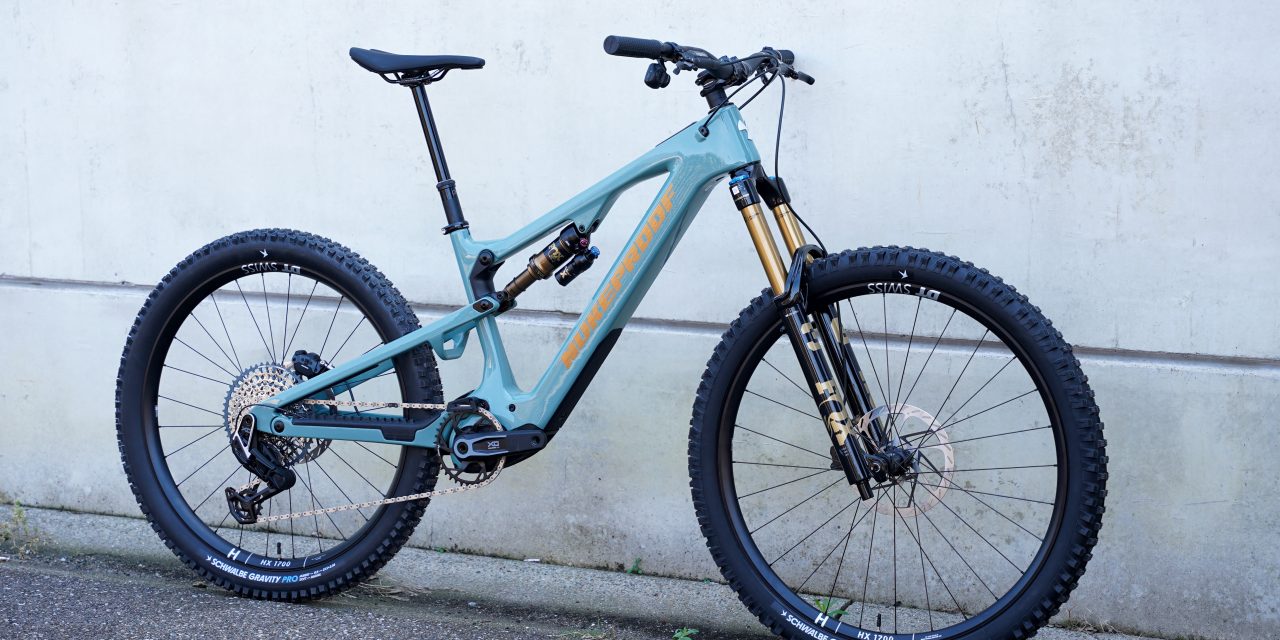
Then you hit the small print: most models use a non-removable 800 Wh battery, with the small frame getting 600 Wh. I understand why. Cleaner lines, stiffer chassis, fewer rattles, better packaging, nicer photos. But in Australia, where a garage in Brisbane can become a proving oven and a road trip to Derby or Bright can put a bike days away from a friendly dealer, non-removable batteries are not just a design choice. They are a bet against the owner’s independence.
The industry keeps promising bikes that think for us. Most riders would settle for bikes that can be diagnosed without begging a server in another hemisphere.
Canyon’s safety tech is fascinating, and slightly cursed
Canyon went full future-lab. Its Roadlite:ON CF concept, developed with Volkswagen, shows V2X communication aimed at warning riders about vehicles and infrastructure hazards. Its Predict road bike concept uses 360-degree sensing, including camera, radar and motion-sensor data, processed on the bike to detect risks. There is also the smart helmet universe: display, audio, voice control, training data and warnings turned into a wearable cockpit.
Here is the irritating bit: I want this to work. I ride on Australian roads, so I do not need lectures about purity from someone who only pedals in Zwiftopia. If a bike can warn a commuter in Sydney that a ute is about to turn through them, terrific. If radar and haptic alerts can stop one driver from saying the classic post-crash nonsense, “I didn’t see them,” bring it on.
But the bike cannot become a rolling terms-and-conditions document. Safety tech must not become another excuse to blame riders for not buying the premium sensor package. A $12,000 road bike with radar, AR and predictive hazard alerts is not transport policy. It is a Silicon Valley apology mounted on 28 mm tyres.
The local shop problem nobody wants to say out loud
The Australian angle is simple. Our shops are already stretched. Good mechanics are scarce, warranty queues are ugly, and too many brands treat dealer support like an optional accessory. Now imagine the next wave of bikes arriving with motor algorithms, cloud diagnostics, locked batteries, app pairing, firmware versions, security modules and compatibility charts written by someone who has never tried to get a commuter back on the road before work on Tuesday.
A smart bike is only smart if the shop can service it quickly, affordably and without performing ritual sacrifice to a distributor portal. Otherwise, it is not innovation. It is planned helplessness with nicer industrial design.
- Can the shop run full diagnostics in-house, or does the bike need to be shipped away?
- How long will batteries, displays, remotes and wiring looms be available?
- Can the bike be ridden if the app, phone or cloud account fails?
- Are firmware updates optional, reversible and clearly explained?
- Can a second owner register and service the bike without a bureaucratic treasure hunt?
- Is the battery removable, replaceable and priced like a bike part, not a hostage note?
Smart should mean serviceable
Panasonic showed its GXM system with a new Remote 801, app integration and the usual promise of a more connected e-bike. Blubrake pushed more compact ABS for e-bikes. Drivetrain and motor integration kept marching forward. None of this is bad. ABS on cargo bikes and commuters could be genuinely useful. Better motor control can make e-MTBs more natural. Connected safety could save skin and lives.
The problem is not technology. Cyclists are not anti-tech. We ride electronic shifting, tubeless tyres, power meters, radar lights and GPS computers that would have looked like witchcraft to a 1990s club rider. The problem is bad technology that removes agency. The best bike tech disappears under you. The worst bike tech demands your email address before it lets you ride to the bakery.
Eurobike’s smart-bike moment should be a warning to every brand trying to drag bicycles into the device economy. Do not build bikes like phones. Phones are miserable to repair, deliberately opaque and obsolete by mood swing. Bikes should be the opposite. A bicycle is one of humanity’s greatest technologies because it is efficient, legible and intimate. You can look at a chain, a tyre, a cable, a rotor, and understand the bargain being made.
If AI helps the motor feel more human, great. If radar helps the rider get home, excellent. If a smart helmet gives a clear warning without turning every bunch ride into a fighter-jet simulation, I will try it. But if the future of cycling is a locked ecosystem where every fault code is a sales opportunity, riders will revolt in the most cyclist way possible: they will keep their old bikes, hoard spare parts and tell everyone at the café that new stuff is rubbish.
That is the column from Frankfurt. The industry has discovered artificial intelligence. Now it needs to rediscover actual intelligence: standards, spare parts, open diagnostics, replaceable batteries, trained mechanics and bikes that still make sense when the Wi-Fi drops. The smartest bike at Eurobike will not be the one with the most sensors. It will be the one your local shop can fix before the weekend.