
Connor Wright Won On Dirt. Road Cycling Should Keep Its Hands In Its Pockets.
Australia has a junior XCO world champion, and the lazy response will be to ask how quickly road racing can harvest him. Wrong. Connor Wright’s rainbow jersey is proof the dirt is not a nursery, it is the main event.
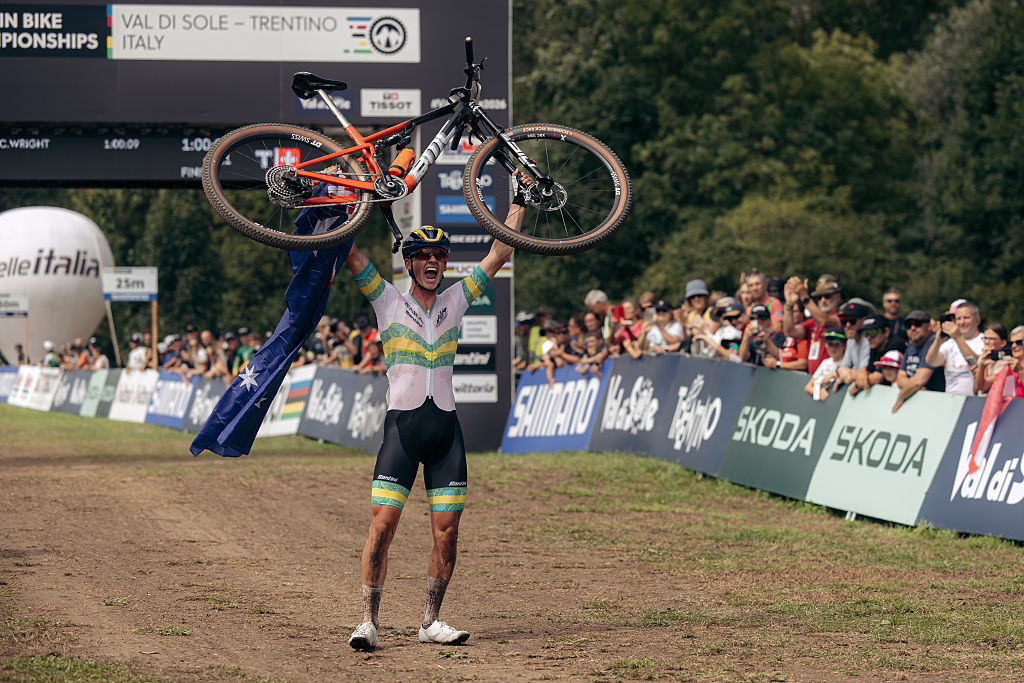
Connor Wright just did the thing Australian cycling spends years writing strategy documents about. On Thursday 27 August 2026, at the UCI Mountain Bike World Championships in Val di Sole, the 18-year-old Western Australian won the junior men’s cross-country Olympic world title. Not scraped it. Not clung on. Won it like a rider who had found the race by the throat and decided not to let go.
He took control on the second of five laps, rode away from Austria’s Michael Hettegger, and finished in 1:00:09. Hettegger was 1:16 down. Switzerland’s Marwan Barhoumi was 1:43 back. That is not a cheeky late move. That is a demolition with mud on its shoes.
This is not a road prospect story
And yet, before the dust has even settled on his tyres, the temptation is obvious. Someone will look at Wright’s engine, his road results, his multi-discipline polish and his recent move toward Tudor’s development orbit, then declare him “one for the road”. Spare us. This is exactly how cycling flattens interesting riders into predictable assets.
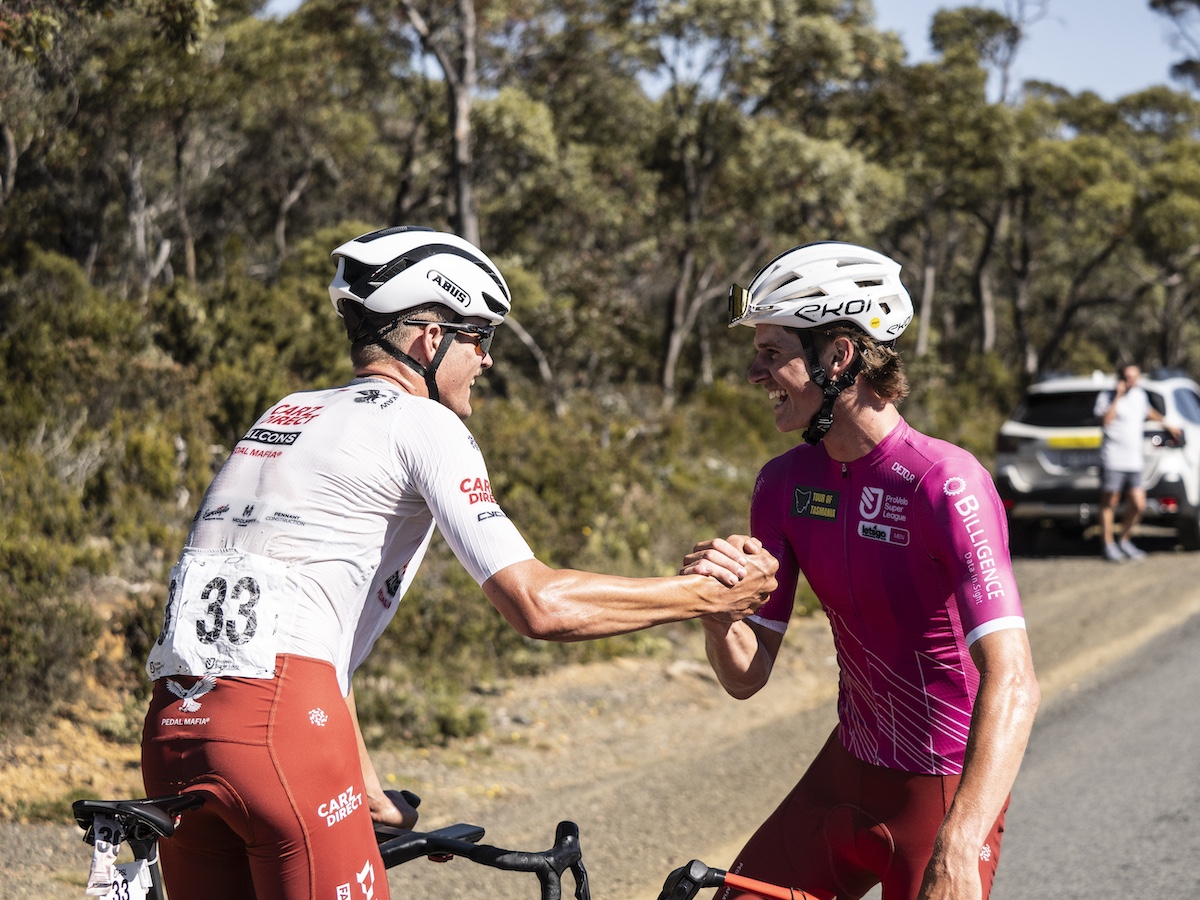
Wright can clearly ride skinny tyres. Earlier this year he was already being spoken about as one of the standouts of the ProVelo Super League generation, with results on the road that made the talent scouts put down their flat whites and refresh their spreadsheets. He has won and podiumed against road kids, shown up in Tasmania, and looked comfortable doing the high-power nonsense that convinces directors a rider can be filed neatly under “future WorldTour motor”.
Fine. But the rainbow jersey he won today was not handed out for sitting at 420 watts on a dual carriageway with a convoy behind him. Val di Sole asks a different question. Can you make power while the bike is skipping under you? Can you corner under stress? Can you punch, recover, descend, remount your ego after a mistake, and still think with lactate turning your skull into soup? Wright answered yes, repeatedly, until the rest of the junior field was racing for silver.
The ugliest habit in Australian cycling is calling a mountain biker “versatile” when what we really mean is “available for road extraction”.
The dirt has already done the hard work
AusCycling did not send Wright to Italy as a mystery packet. He was returning for his second junior MTB Worlds after finishing sixth in Crans-Montana in 2025. He arrived with four straight UCI XCO Junior Series wins in Europe, capped by XCC and XCO victories at Nové Město na Moravě. He had already stacked up national MTB titles and the Oceania XCO crown. If you were surprised by the rainbow jersey, you were not watching. That is allowed, but do not confuse your inattentiveness with a miracle.
The proper lesson is not that mountain biking is producing better road riders. The proper lesson is that mountain biking is producing complete bike racers, and road cycling should be humble enough to admit it wants what dirt built. The balance, the aggression, the line choice, the ability to keep pedalling when the course looks like it was designed by an angry trail builder with a hangover, that is not garnish. That is the craft.
Australian cycling has a bad habit of rewarding only the version of talent that fits neatly into a televised January road race. A kid from WA wins on dirt, and suddenly we ask how it translates to Europe, to development teams, to the WorldTour. Here is a more useful question. What would it take for him to become the best mountain biker in the world, full stop, without treating that ambition as a temporary phase before he gets a team-issue aero helmet and learns to suffer through crosswinds in Belgium?
Road teams are not villains, but they are hungry
Let’s not pretend the road side is stupid. It sees riders like Tom Pidcock, Pauline Ferrand-Prévot, Mathieu van der Poel and the whole modern off-road aristocracy. It sees that technical disciplines make riders who can handle chaos rather than merely survive it. It sees that a junior who can win XCO at Worlds might also make a frightening puncheur, classics pest, gravel assassin, or week-long stage race problem.
That is why the phone calls come. Development contracts. Nice equipment. Camps. Medical support. Race days. Travel. A structure that mountain biking, especially in Australia, often struggles to match. You cannot blame a rider for taking a professional road opportunity. You can blame the sport if that opportunity becomes the only serious one.
- Fund junior and under-23 MTB racing like it is medal infrastructure, not a hobby with entry fees.
- Give XCO riders proper European blocks without making them moonlight as road prospects to justify the airfare.
- Stop measuring every talent by WorldTour convertibility.
- Build domestic MTB events that feel like elite sport, not car-park admin with timing chips.
- Let riders like Wright choose dirt as a destination, not as evidence for a road contract.
The local bike shop lesson
There is another angle here, and it matters for everyone who actually rides rather than just consumes race graphics. Wright’s win is brilliant for Australian shops, clubs and trail networks because it gives dirt kids a reference point that is not imported. Not every junior needs to worship the Tour. Some want a hardtail, a local loop, and the permission to take off-road racing seriously without being told they will “graduate” to road.
That matters in Perth, Canberra, Derby, Maydena, Bright, Nerang and every scruffy local trailhead where parents are still learning that a proper junior MTB programme is not just kids doing skids between sausages. A rainbow jersey changes the conversation. It lets clubs ask councils for trail access without sounding like they are begging for a playpen. It lets shops sell proper junior kit without apologising for the price. It lets young riders imagine a future that has roots in dirt.
And yes, there is a marketplace angle, because there always is. Bikes follow heroes. If Australia wants more kids racing XCO, it needs affordable race-ready mountain bikes, not just enduro sleds with mortgage-payment forks or gravel bikes dressed up as adventure therapy. A junior world title should embarrass distributors into supporting actual cross-country stock on shop floors. Lightweight hardtails. Fast tyres. Sensible gearing. Shoes that do not weigh as much as a brick. The stuff that turns enthusiasm into starts, not just Instagram saves.
Do not make him a symbol too quickly
The other trap is turning Wright into a national saviour by breakfast. He is 18. Let the kid breathe. Junior rainbow jerseys are not guarantees, and cycling history is littered with teenagers who were treated like public infrastructure before they had worked out how to order dinner in a foreign language. The point is not to crown him Australia’s next anything. The point is to notice what he has already done, and to build a system that does not require one exceptional teenager to prove the discipline deserves oxygen.
Today, Connor Wright won on dirt. He did it in green and gold, against the world, on a course that punishes passengers. The road world will look at that and see an engine. The smarter read is simpler and more threatening. Australia has a mountain biker who can win the biggest race in his category. Treat that as the story, not the prologue.