
Australia Is Crushing E-Bikes While Europe Is Building The Ones Cities Actually Need
Frankfurt just showed us the future of urban cycling. Australia, meanwhile, has reached for the crusher first and the bike lane second.
The most important cycling story this week is not a Tour selection, a new aero handlebar, or another gravel bike pretending to be a farm implement with feelings. It is this: Eurobike 2026 has just wrapped in Frankfurt, and the bike industry’s centre of gravity has shifted hard towards urban e-mobility, connected bikes, cargo logistics and the boring, brilliant business of replacing car trips.
That should be fantastic news for Australia. We have clogged cities, school-run chaos, delivery riders doing unpaid road-safety research, and a generation of people who would happily ride 4km to work if the trip did not feel like volunteering for a near-miss compilation. Instead, our political response has largely been to panic about illegal fat-tyre throttle monsters and write laws with the subtlety of a bent derailleur hanger.
Eurobike got smaller. The ideas got bigger.
Eurobike ran from 24 to 27 June in Frankfurt this year under a deliberately more compact format. The organisers cut the show down, separated the bike-and-pedelec core from the broader Mobifuture e-mobility circus, and pushed harder into specialist retail, everyday mobility and commercial use. Cyclingnews described a noticeably smaller show, down to three halls that were not exactly bursting at the seams. The old industry flex is gone. Good. The boom-time theatre needed a cleanout.
For years, bike trade shows have been temples to marginal gains and showroom nonsense. A lighter cockpit. A new lay-up. Another model with a name like a password reset. Fun, yes. Essential, rarely. What mattered in Frankfurt this week was not whether a road bike saves two watts at 48km/h under a mannequin with perfect hamstrings. It was whether the bicycle industry has finally accepted that its biggest market is not the bloke with shaved legs and three unpaid entry fees in his inbox. It is the person trying to get a child, a laptop, a grocery haul and themselves across town without buying a second SUV.
The future of cycling will not be won by making bikes look less like bikes. It will be won by making cities stop treating bikes like a clerical error.
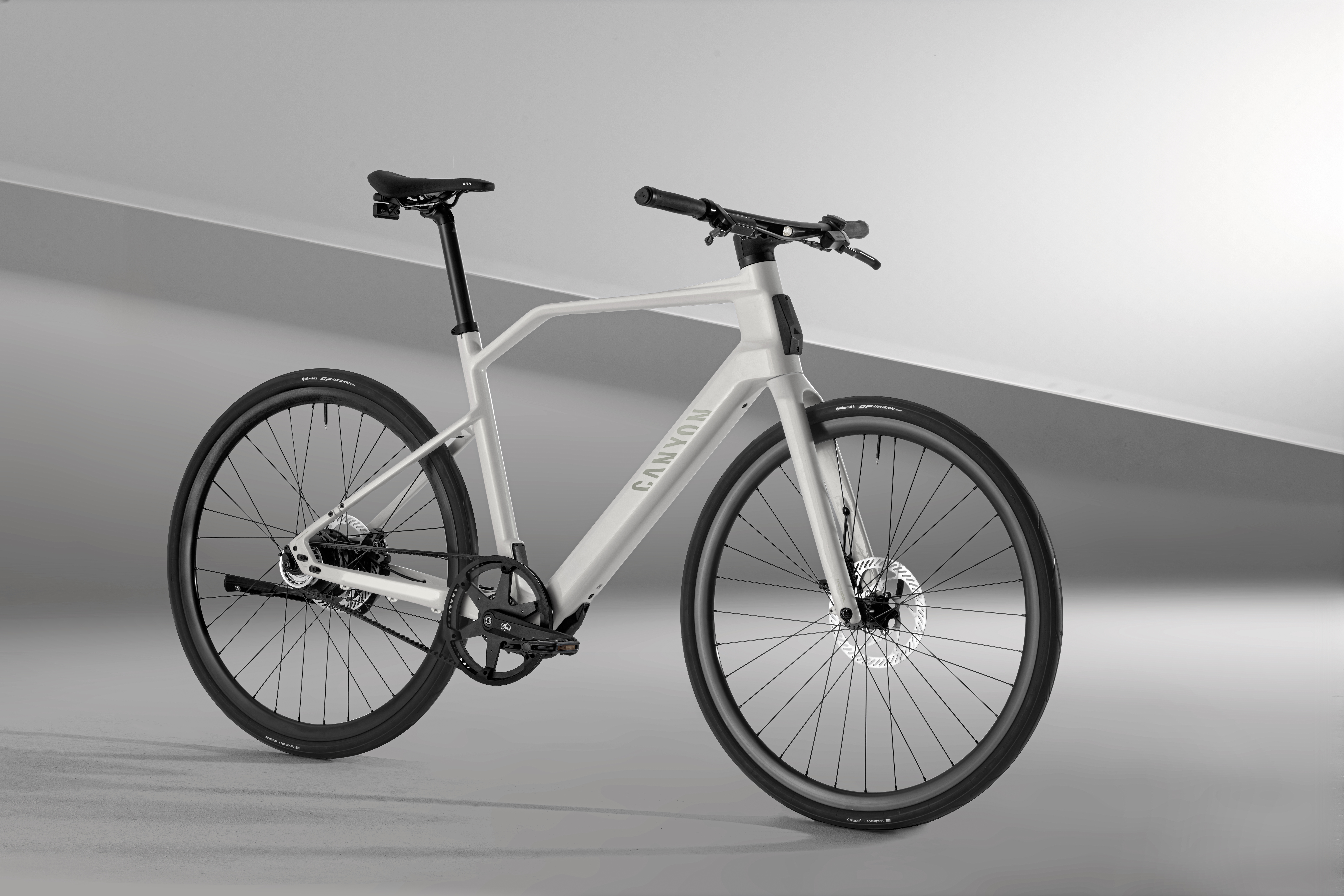
Canyon’s connected e-bike is clever. It is also a confession.
The most telling launch was Canyon’s Roadlite:ON with V2X, short for Vehicle to Everything, technology developed with Volkswagen. In plain English, the bike can talk to compatible cars and infrastructure. A nano-board in the downtube and a GPS antenna in the headtube can send signals to vehicle displays. The rider gets haptic alerts through the grips and visual information through a connected device. It has radar, a dynamic brake light, Bosch assistance and the kind of safety pitch normally reserved for SUVs with names like Territory Violence Edition.
It is genuinely clever. It is also slightly depressing. A bicycle now needs to announce itself electronically to a car because too many road systems still behave as if the rider is an unexpected wildlife hazard. The tech is not the villain. The villain is the idea that vulnerable road users must keep buying defensive gadgets while vehicles get taller, heavier and more insulated from consequence.
Australia is regulating symptoms, not transport
Now look at Australia. New South Wales is moving towards a harder line on illegal e-bikes, including seizure and crushing powers. Bikes over 500W are already outside the legal road category, legal assistance must cut out at 25km/h, and throttle or walk-assist behaviour is limited to 6km/h. NSW is also shifting towards a 250W cap and EN 15194 compliance, with a transition deadline of 1 March 2029 for certain existing bikes.
Queensland is going even sharper from 1 July 2026. Police can seize and destroy illegal devices. Random breath testing will apply to riders of bicycles, e-bikes, e-scooters and other personal mobility devices in public places. E-bike motors can only assist to 25km/h. A 12km/h limit applies on footpaths and when passing pedestrians on shared paths. From 31 August, riders must be 16 with a licence, with some exemptions and parental-supervision carve-outs. There are big fines too, because of course there are. Australia’s favourite infrastructure substitute is a penalty notice.
Let’s be honest: some of this is necessary. A throttle-only electric motorbike being sold to a teenager as a bicycle is not cheeky innovation. It is a regulatory scam with a battery. If it does 45km/h without pedalling, it belongs under motorbike rules, not next to a pensioner on a step-through commuter. Dodgy imports, cooked batteries and pretend pedals have done real damage to public trust. Shops and online sellers who blur the line should be named, fined and made to sit through a full council transport meeting without coffee.
But the danger is that governments lump the whole e-bike movement into the same moral panic. A compliant cargo bike carrying two kids to school is not a menace. A delivery rider on a certified pedal-assist bike is not the reason your footpath feels unsafe. A 68-year-old using a mid-drive commuter to flatten a hill is not the collapse of civilisation. The problem is illegal electric motorbikes, hostile street design and a retail grey zone. Treating every assisted bike as suspicious is like banning road bikes because a triathlete once rode through a red light while looking at their stem.
- Go hard on illegal throttle-only and overpowered devices, especially sellers who market them as road legal.
- Build protected bike lanes before pretending enforcement alone will make mixed traffic safe.
- Create clear national labelling so buyers know what is legal in every state, not just what a webshop claims.
- Support cargo bikes for school runs, trades and local delivery instead of treating them as novelty props.
- Stop confusing e-bike regulation with anti-bike politics. They are not the same thing.
The bike shop is now the front line
This is where local retailers matter. A decent bike shop will tell you what the motor is, what standard the battery meets, whether the assistance cuts out properly, and whether the thing can be serviced without a Ouija board. A dodgy seller will tell you it is “street legal” in the same tone a bloke at the pub tells you his carbon wheels are definitely genuine. The next few years will sort the grown-ups from the box-floggers.
For Yellow Jersey readers, the takeaway is simple. If you are buying an e-bike now, buy boringly legal. Ask for compliance details. Ask about battery certification. Ask who services the motor. Ask whether it still behaves like a bicycle when the battery dies. If the answer is vague, walk away. If the pedals look decorative, run.
The real tragedy would be letting illegal electric motorbikes poison the public conversation just as proper e-bikes are becoming useful, refined and normal. Frankfurt showed an industry trying to move beyond sport and into transport. Australia has a choice: build rules that help that happen safely, or keep swinging the crusher around while everyone climbs back into traffic.
Cycling does not need more permission to be useful. It needs space, standards and a bit less hysteria. The e-bike is not the enemy. The enemy is the lazy belief that a city full of cars is normal, but a city full of bicycles needs a police operation.